
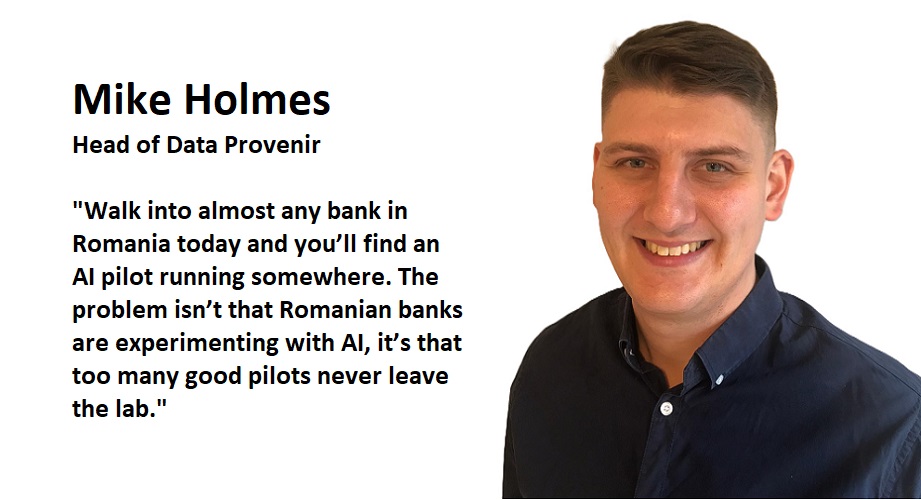
Walk into almost any bank in Romania today and you’ll find an AI pilot running somewhere. A chatbot trial in customer service. A model in the data science team’s sandbox, quietly scoring a shadow portfolio. A proof of concept for document extraction that impressed everyone in the demo and then went quiet.
an article written by Mike Holmes, Head of Data – Provenir
None of this is a failure. It’s what responsible experimentation looks like. The problem isn’t that Romanian banks are experimenting with AI, it’s that too many good pilots never leave the lab. They stay as pilots for eighteen months, then two years, and the institution ends up explaining to its board why the AI strategy is still, technically, a strategy.
This isn’t a Romanian problem specifically. It’s an industry-wide one, and it’s exactly why the AI conversation in financial services has shifted this year. The question is no longer “are you experimenting with AI?” Every serious institution is. The question the market is asking is sharper: can you run it in production, at scale, under control?
Why pilots stall
There’s a predictable pattern to why AI initiatives get stuck, and it rarely has anything to do with the quality of the model.
The architecture wasn’t built for production. A model trained in a data science lab and a model running inside a live credit or fraud decision are different engineering problems entirely. The gap between “it works in the lab” and “it’s monitored, governed, and safe to run against real customers at 2am on a Sunday” is where most initiatives die.
Governance was an afterthought. Under the EU AI Act supervisory expectations, a credit or fraud decision influenced by AI needs to be explainable, auditable, and traceable back to a human-accountable process, not just accurate. Bolting governance onto a pilot after the fact is far harder than building it in from day one, and most labs don’t build it in from day one, because a pilot’s job is to prove a concept, not survive an audit.
Every new use case meant a new integration project. Even where a pilot proves genuinely valuable, scaling it across products, portfolios, and business lines has historically meant a fresh integration effort each time, new data plumbing, new orchestration, new monitoring, repeated for every use case and every AI tool the institution wants to bring in. None of these are reasons to slow down on AI. They’re reasons the architecture underneath it matters more than the model itself.
What “beyond the lab” actually requires
Scaling AI in a regulated lending business isn’t a bigger version of a pilot. It requires three things a pilot, by design, doesn’t have.
A decisioning environment the AI runs inside of, not alongside. Agents that assist with document classification, income extraction, or credit memo drafting need to operate within the same governed workflow as your existing rules and models, not in a parallel system that must be reconciled with production afterwards.
When AI and deterministic decisioning share one environment, a complex or uncertain case can route to human review automatically, and every decision, AI-assisted or not, is logged the same way, explainable and audit-ready by default rather than by exception.
A closed loop, not a one-off deployment. A model or agent that goes live and is never revisited is already becoming a liability. Production scale means validating every change against real historical data through simulation and replay before it goes live, then continuously monitoring performance afterwards. That closed loop is what turns “we launched an AI pilot” into “we have a system that gets better every quarter”, and it’s the difference between a lab result and a compounding advantage.
Composability without a fresh integration project every time. Most banks have already invested in AI tools
internally built, from a core banking partner, from a specialist vendor. The institutions that scale fastest are the ones whose decisioning platform can expose its data and workflows as standard, governed connections that any compatible AI tool can plug into, rather than requiring a bespoke integration for every new agent or assistant. This is a genuinely solved problem today via open standards like MCP (Model Context Protocol).
Governed, not autonomous
It’s worth naming the trap explicitly, because the industry keeps walking into it: the temptation, once a pilot proves itself, is to reach for language about autonomous agents that “investigate, orchestrate and optimise” on their own initiative. It’s an appealing story. It is also not the story a risk committee, regulator or customer wants to hear about a decision that affects their credit access.
The institutions that will move beyond the lab successfully aren’t the ones chasing autonomy. They’re the ones building governed execution: agents that combine real-time data with AI-based interpretation to handle high-volume, routine cases end-to-end, operating strictly within guardrails the institution itself defines, with every exception surfaced to a human. Less dramatic to announce. Considerably easier to defend to a supervisor, and considerably more likely to still be running, unmodified in its risk profile, twelve months from now.
Scale looks like infrastructure, not announcements
For Romanian banks specifically, this is a genuine opportunity rather than a disadvantage of moving second. You don’t need to run the industry’s largest AI experiment, you need a decisioning platform that already operates at production scale, already carries the audit trail regulators expect, and already lets you plug in the AI capability you’ve built or bought without a bespoke integration project each time.
That’s a different question to ask of a technology partner than “how advanced is your AI.” It’s “how many decisions do you already run like this, for how many institutions, under how much regulatory scrutiny, for how long?” That track record, not the pilot, not the press release, is what gets an AI initiative out of the lab and onto the board’s list of things that are working.
The banks that get this right in the next eighteen months won’t be the ones with the most experiments. They’ll be the ones who stopped treating scale as the next pilot and started treating it as an architecture decision.
_________
Mike Holmes is a highly respected data and analytics leader, specialising in predictive modelling and credit risk management. He has a broad knowledge of data science, business intelligence and data architecture principles. Over his career, he’s embedded over 100 models, enterprise-wide, which have made millions of decisions across over £90bn of assets.








Banking 4.0 – „how was the experience for you”
„To be honest I think that Sinaia, your conference, is much better then Davos.”
Many more interesting quotes in the video below: