Banking 4.0, 2026: agenda & key conversations
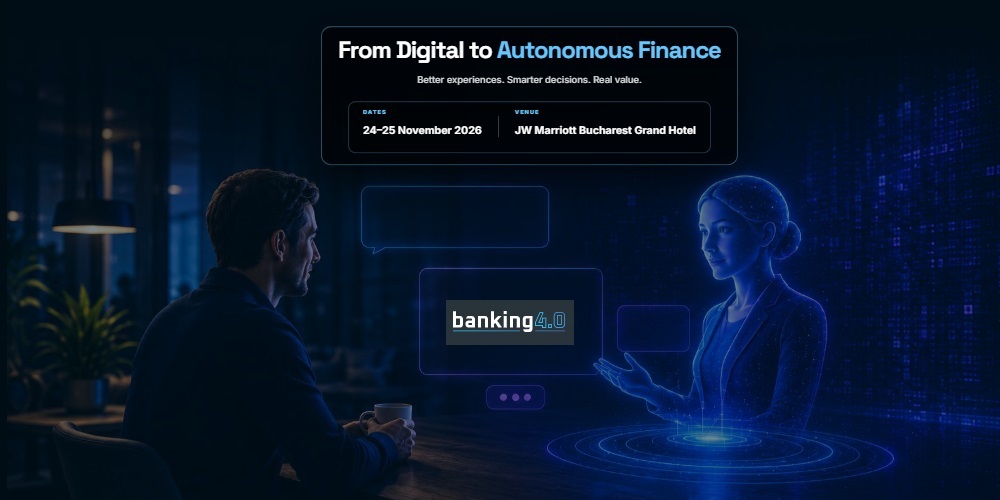
This year, the Banking 4.0 International Fintech Conference looks beyond digitalisation to explore the next evolution of financial services: intelligent, autonomous financial systems. The conference examines the shift from automation to autonomy in banking and asks how financial services will be redefined in the age of AI, Open Finance and Digital Assets.
Follow the event agenda to get a better understanding of the topics that will shape the conversation and how these ideas will come together throughout the conference.
MAIN STAGE
Day 1 (November 24) – The Architecture
Panel 1 – The New Architecture of Finance
Ecosystems Replace Institutions as the Primary Unit of Value Creation
Banking has traditionally been built around institutions: banks own the customer relationship, control the product and operate the infrastructure. But the next generation of financial services is increasingly being built through ecosystems.
Embedded finance, Open Finance, platform business models, stablecoin ecosystems and new partnerships are bringing together banks, fintechs, Big Tech and non-financial companies. The winners may no longer be those that offer the most products, but those that orchestrate the most valuable networks.
This panel explores how the architecture of finance is changing—and what happens when the bank becomes one participant in a much larger financial ecosystem.
Key questions
When banking becomes a network rather than an institution, who captures the value?
If ecosystems—not institutions—become the primary unit of value creation, what is left for the bank to own?
Will the future of finance belong to the institutions that build the best products—or to the platforms that orchestrate the ecosystem around them?
Panel 2 – Digital Sovereignty: Who Controls the Future of Money?
The future of finance is increasingly being shaped by digital infrastructure—and the question of who controls that infrastructure is becoming a question of economic sovereignty.
Payments, digital currencies, stablecoins, cloud platforms, AI and data are becoming critical components of the financial system. As these layers become increasingly interconnected, Europe faces a strategic question: can it remain in control of its financial future if the underlying digital infrastructure is controlled elsewhere?
This panel explores the new dimensions of financial sovereignty—from digital euro and European payment infrastructure to stablecoins, CBDCs, cloud, AI and data sovereignty—and examines what Europe must own, control or influence to remain strategically autonomous.
Key questions
Can Europe remain economically sovereign without sovereign digital financial infrastructure?
Who controls the infrastructure of money—and therefore the future of financial sovereignty?
The panel could revolve around one fundamental idea:
Financial sovereignty used to mean controlling the currency. In the digital economy, does it now also mean controlling the infrastructure through which money moves, data flows and financial decisions are made?
Panel 3 – AI-native institutions: When Finance Starts Operating Itself
The next transformation in banking is not simply about using AI to do existing tasks faster or better. It is about rethinking the financial institution around AI-native operations.
What does a financial institution look like when AI agents can manage treasury, monitor compliance, interact with customers, make decisions, and execute transactions autonomously? When machines can transact directly with other machines, the traditional boundaries between people, processes and technology begin to disappear.
This panel explores what an AI-native financial institution actually looks like—and what must fundamentally change in its operating model, governance, workforce and relationship with customers.
Key questions
If AI becomes the operator of the financial institution, what becomes the role of humans?
When AI can operate the financial institution, what should humans still be responsible for?
Are we building financial institutions where humans use AI—or financial institutions where AI operates and humans govern?
Panel 4 – The Reinvention of Money Movement
From Instant Payments to Autonomous Transactions
Banking is becoming autonomous. Infrastructure is becoming programmable. Finance is becoming an ecosystem. Payments should therefore be presented as the mechanism through which this new financial system actually moves value.
Payments are no longer simply about moving money from A to B. Instant payments, digital wallets, embedded finance, tokenization, programmable money and AI agents are changing who initiates transactions, how they are executed and what a payment actually means.
As finance becomes increasingly embedded and autonomous, the payment itself may become invisible—triggered by software, executed instantly and increasingly initiated by machines rather than humans.
The panel explores the future of money movement and the shift from payments as a transaction to payments as an intelligent, programmable and autonomous layer of finance.
Key questions
What happens to payments when money can move instantly, programmatically and autonomously—without a human initiating the transaction?
When AI agents can move money on our behalf, what will a “payment” even look like?
Panel 5 – Programmable Infrastructure: The New Operating System of Finance
Finance is moving from fixed infrastructure to programmable infrastructure. APIs, instant payments, tokenization, programmable money, cloud platforms, interoperability and Open Finance are transforming the foundations on which financial services are built.
The next competitive advantage may no longer be the product itself, but the infrastructure that makes financial products programmable, composable and scalable.
This panel explores how financial institutions can turn infrastructure into a strategic capability—and what happens when the boundaries between banks, platforms, payment networks and technology providers start to disappear.
Key questions
Who will control the new operating system of finance and what will financial institutions (banks) need to build, own or reinvent to stay competitive?
When infrastructure becomes software, does the financial institution (bank) become a platform—or just an application running on someone else’s infrastructure?
Day 2 (November 25)– The Governance
Panel 6 – Trust in the Age of Autonomous Finance
As finance becomes increasingly autonomous, trust is becoming more complex. AI agents may make decisions, software may initiate transactions, identities may be synthetic, and financial systems may operate with less human intervention.
The challenge is no longer simply protecting systems from cyberattacks. It is about knowing who—or what—we can trust when machines make decisions and money moves automatically.
This panel explores how financial institutions can build trust into an autonomous financial ecosystem—from AI-driven fraud and deepfakes to digital identity, zero-trust architectures and post-quantum security.
Key questions
How do we build trust when AI makes decisions, identities can be synthetic, and software can move money autonomously?
When machines make financial decisions and move money without human intervention, who—or what—do we trust?
Panel 7 – Regulation as an Innovation Platform
Europe has built one of the world’s most ambitious regulatory frameworks for the digital financial economy. From PSD3 and the PSR to FIDA, the AI Act, DORA, MiCA and digital identity, regulation is increasingly shaping not only how financial institutions operate, but also what new services and ecosystems they can build.
The question is whether regulation can move beyond protecting consumers and managing risk to become an enabler of innovation, interoperability and competition.
This panel explores how Europe can turn regulatory frameworks into common infrastructure for the next generation of financial services—and whether a well-designed regulatory environment can become a genuine competitive advantage.
Key questions
Can Europe turn regulation from a constraint on innovation into an infrastructure for innovation—and make it a competitive advantage? Can regulation become Europe’s new innovation infrastructure?
Does regulation slow innovation—or can the right regulation actually accelerate it?
If Europe gets the rules right, could regulation itself become one of its most powerful technology platforms?
Panel 8 – From Customer Experience to Autonomous Experience
This panel takes the discussion beyond UX and personalization into a much bigger question: what happens to the customer relationship when the customer is no longer the primary user of the bank?
For decades, financial institutions have competed to create better digital experiences—faster apps, simpler journeys, personalized offers and seamless payments. But autonomous finance changes the relationship fundamentally.
What happens when customers stop managing their money themselves and AI agents start making financial decisions on their behalf?
From financial agents and invisible banking to embedded finance, hyper-personalization and AI-driven recommendations, the next generation of financial services may be less about customers interacting with banks—and more about AI interacting with financial institutions for customers.
This raises a fundamental question: who owns the customer relationship when the customer delegates financial decisions to an AI?
Key questions
When AI becomes the customer’s financial decision-maker, will people still choose banks—or will their AI assistants choose for them?
When AI chooses where our money goes, who owns the customer relationship?
If the customer no longer comes to the bank, how does the bank remain relevant?
Panel 9 – The CEO Agenda: Building the Autonomous Financial Institution
Autonomous finance is not simply a technology transformation. It is a fundamental transformation of the financial institution itself.
What does a financial institution become when AI agents make decisions, infrastructure becomes programmable, customer interactions become autonomous, and financial services increasingly operate in the background?
For CEOs and industry leaders, the question is no longer whether this transformation will happen, but how to prepare the organization for it.
This closing panel brings together leaders from banking, central banking, fintech, Big Tech and consulting to discuss the strategic choices ahead: how the institution must evolve, how leadership and talent will change, what capabilities will become obsolete, where to invest today, and what the financial institution of 2035 could look like.
Key questions
What must financial institutions become today to remain relevant in the autonomous economy of 2035?
If the financial institution of 2035 is fundamentally different from the financial institution of today, what must CEOs start changing now?
SECONDARY STAGE – BANKING LABS
The secondary stage will serve as the exhibition and demonstration area. The organisers will select a range of innovative services, products, and applications to be showcased in the Banking Labs.
This is also where experts can exchange experiences and engage in practical discussions around the technical solutions being presented. The Banking Labs offer significant potential not only for validating solutions, but also for developing new partnerships and business opportunities.
Developers of innovative services and products, as well as those interested in showcasing and promoting them, are invited to take part. Don’t miss this opportunity to present your solution, receive valuable feedback, and connect with potential partners.
Register here: contact@banking40.ro
_____________
Banking 4.0 — where innovation meets reality and industry leaders shape what’s next
Banking 4.0 brings together around 300 experts, innovators, and technology leaders from more than 20 countries, representing around 150 organizations across the financial ecosystem. Participants include traditional and digital banks, insurers, telecom operators, software developers, payment networks, card processors, infrastructure providers, consulting and law firms, regulators, and industry associations.
As AI systems become capable of acting autonomously, infrastructure grows increasingly programmable, and ecosystems emerge as the new engines of value creation, financial institutions face a defining question: What comes after digitalization? Banking 4.0 is where that question is explored – and where practical answers take shape through debate, collaboration, and real-world innovation.
Mark your calendar for 24–25 November and join us at the Marriott Grand Hotel Bucharest.





Dariusz Mazurkiewicz – CEO at BLIK Polish Payment Standard
Banking 4.0 – „how was the experience for you”
„To be honest I think that Sinaia, your conference, is much better then Davos.”
Many more interesting quotes in the video below: