
According to an analysis by Global Payments, over the past four years, the density of payment terminals in Romania has increased approximately 2.5 times, from 15 to 38 terminals per 1,000 inhabitants, bringing the country close to the European average of 39
terminals per 1,000 inhabitants. This confirms the rapid expansion of Romania’s card payment acceptance infrastructure.
Card payments are gaining increasing ground in Romania, while the POS terminal infrastructure continues to expand rapidly. At the beginning of 2026, the number of payment terminals exceeded 729,000, including both physical POS terminals and terminals processing card-not-present transactions (via e-commerce, payment links). In recent years, Romania has recorded one of the fastest rates of growth in Europe in terms of digital payment acceptance infrastructure, from traditional in-store POS terminals to solutions that turn mobile phones into payment terminals.
By the end of 2025, Romania had already recorded approximately 1.8 billion card payment transactions. A major boost came from legislative changes introduced in 2023–2024, which expanded the requirement for merchants to offer cashless payment options. The impact quickly became evident, with payment terminals becoming increasingly widespread, including among small businesses in rural areas and local markets. According to Global Payments data, at the beginning of 2026, amid the new legislative changes, the number of requests for terminal installations was nearly 10 times higher than in the same period of the previous year.
„Legislative changes have played an important role, but we are also seeing a clear change in the behavior of merchants and consumers. Today, card payment is available in more and more places – from shops and restaurants to small street vendors or in rural areas. Romania is no longer just an expanding market, but one that shows maturity in accepting electronic payments. The next stage will be to expand and diversify payment options through simpler and more accessible digital solutions – payment links or softPOS, for example, which allow merchants to accept payments directly on their mobile phone,” said Ionela Mitran, Country Manager Global Payments Romania.
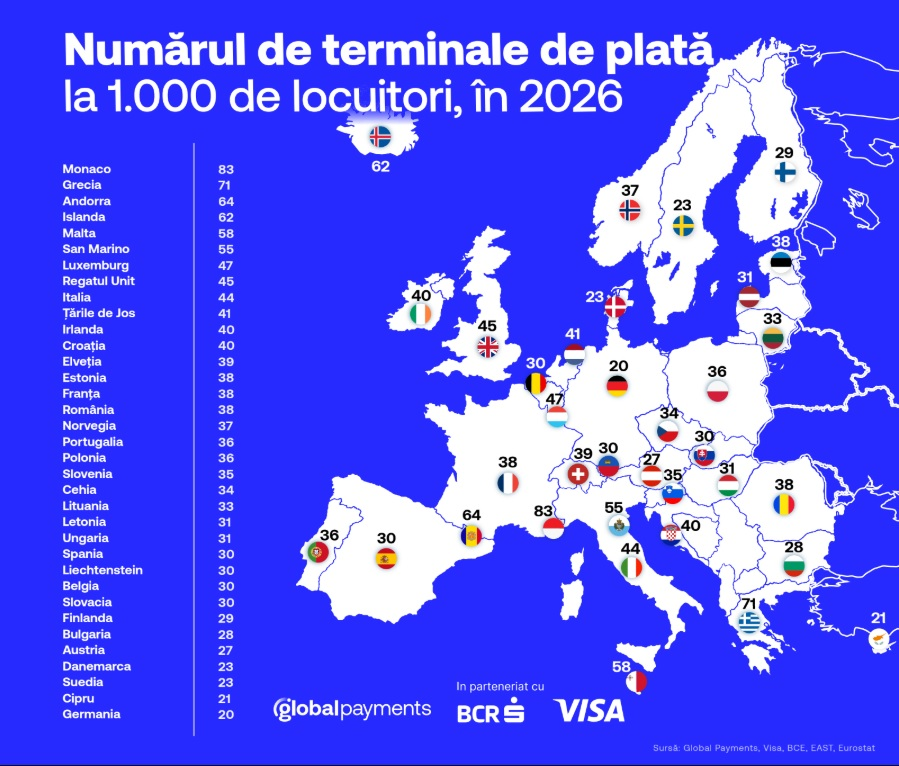
The rapid expansion of payment infrastructure has brought Romania to levels comparable with some of Europe’s largest economies. With 38 payment terminals per 1,000 inhabitants, Romania ranks ahead of European markets such as Norway (37), Spain and Belgium (30 each), Austria (27) and Germany (20). At the same time, it is on par with France and close to Switzerland and the Netherlands.
Romania also holds a strong position among Central and Eastern European (CEE) markets, surpassing Hungary (31), Poland (36), Slovenia (35), Slovakia (30) and Bulgaria (28). Among the CEE markets analysed, only Croatia (40) has a higher density of payment terminals.
Southern Europe stands out for its high density of payment terminals, with Monaco (83), Greece (71), Malta (58) and Italy (44) ranking among the top 10. Strong tourism activity and a well-developed HoReCa sector contribute to the expansion of payment infrastructure, as high visitor numbers and frequent interactions between merchants and consumers create greater demand for payment acceptance points.
Germany remains one of the European markets with the lowest density of payment terminals (20), despite the size of its economy and population. In the absence of a legal requirement to accept international payment cards, some merchants continue to accept only domestic cards or cash. Terminal density increased from 12 per 1,000 inhabitants in 2022 to 20 in 2026, indicating
a slower pace of adoption compared with other European markets.
By contrast, Romania is among the European markets that have rapidly closed the gap in recent years, driven by the expansion of payment acceptance infrastructure and the growing adoption of digital payments. In the second half of 2025 alone, the number of payment terminals increased by more than 161,000, representing a 28.4% rise compared with the first half of the year. This growth was also supported by legislative changes requiring businesses to accept cashless payments.
Beyond the increase in the number of terminals, this development brings tangible benefits to both merchants and consumers. For businesses of all sizes, accepting electronic payments offers greater flexibility, helps meet evolving customer preferences and reduces the risk of lost sales due to limited payment options. At the same time, digital solutions enable even small businesses to accept payments without investing in traditional POS terminals.
For consumers, this means greater freedom to choose how they pay, faster transactions and access to digital payment options in an increasing number of locations, including smaller communities and rural areas.
As a result, accepting electronic payments is becoming not only a way to comply with regulatory requirements, but also a factor in business competitiveness and consumer convenience.
______
The statistics are based on data provided by Global Payments, Visa, the European Central Bank, the European Association for Secure Transactions, National Bank of Romania (BNR) and Eurostat, as well as information from other public registers, and include all registered terminals. Therefore, the data may also include terminals that are no longer in use, for example in the case of merchants who have suspended or ceased their activity but have not disconnected their terminals.









Banking 4.0 – „how was the experience for you”
„To be honest I think that Sinaia, your conference, is much better then Davos.”
Many more interesting quotes in the video below: