


Revolut told its employees last week that their shares are worth $2,017 apiece, making the company worth $115 billion. That makes the 11-year-old fintech—oops, bank—more valuable than US Bank and PNC, and in line with Capital One. Compared to Revolut, Nubank has double the customer base, 63% higher profit, but just 58% of the valuation. Nubank now trades at 23x earnings and 9.6x revenue. Apply those multiples to Revolut and you get a valuation between $40 billion and $58 billion.
At a $115b valuation, investors are paying 65x earnings for illiquid common stock in a company whose CEO has said it won’t list before 2028, on the theory that a bank which just started lending will never be valued like a bank. Sign me up (not)!
𝗠𝘆 𝘁𝗮𝗸𝗲: This valuation rests on one big assumption: that Revolut will/can become one of the largest financial institutions in the world without ever being priced like one.
𝗔 𝗯𝗿𝗼𝗮𝗱𝗲𝗿 𝗾𝘂𝗲𝘀𝘁𝗶𝗼𝗻: Revolut is a bank—it has banking licenses in 30+ markets. Why is it still getting fintech multiples?
an article by Ron Shevlin, Chief Research Officer at CornerStone Advisors
Revolut told its employees last week that their shares are worth $2,017 apiece, making the company worth $115 billion. That makes the 11-year-old fintech—oops, bank—more valuable than U.S. Bancorp and PNC, and in line with Capital One’s valuation.
The latest deal moves at least $750 million of stock—which means two-thirds of 1% of the equity sets the price of the other 99.3%. Every company would love to name its own share price. Only a few—like Revolut—get to.
My take: This valuation is insanity (but we do live in an insane world). It rests on one big assumption: that Revolut will/can become one of the largest financial institutions in the world without ever being priced like one.
Nobody in Public Markets Pays 65x For This
Revolut’s 2025 results deserve their due: revenue up 46% to £4.5 billion, pre-tax profit up 57% to £1.7 billion at a 38% margin, retail customers up 30% to 68.3 million. A $115b valuation translates to 19x trailing revenue, 50x pre-tax profit, 65x net profit.
No large financial institution trades anywhere near there. The best-run banks sit in the low-to-mid teens. Barclays, which Revolut just passed in market value, generated 4.7 times Revolut’s net profit last year and trades at 11 times earnings.
Scenarios: Take Revolut’s $1.76 billion of net profit, compound it four years at three growth rates, and apply two exit multiples.
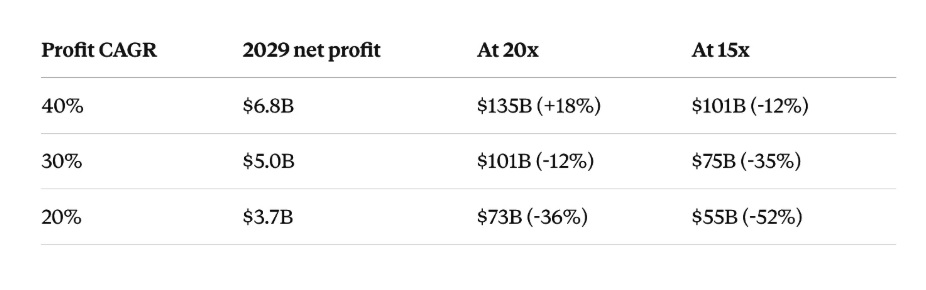
Just one cell in that grid clears today’s price. Reaching it takes four straight years of 40% profit growth and a 20x multiple—that no large bank sustains—and it pays about 4% a year for the trouble. At a 15x multiple, the bank’s—oops, fintech’s—valuation is down 12% from today’s.
If growth slows to 20%—which would still make Revolut one of the fastest-growing institutions on the planet—a 20x multiple costs the new investors half their money.
The Buyers Can Do This Math Too
Nobody writing a check at $2,017 is confused about the multiple. Four reasons why they’re writing checks:
. They’re underwriting the next buyer. Revolut has told investors it’s targeting $150 billion to $200 billion at IPO. Buy at $115 billion, sell into that book in 2028, collect 30% to 74%. That works whether or not 65x trailing earnings is defensible, right up until the public market declines to pay that number.
. Fund math beats asset math. A $200 million check in a $10b fund is 2% of the portfolio. The upside dwarfs the downside, and a stake in Europe’s most valuable startup looks good in the fund’s marketing deck whether or not it ever pays off.
. The mark is part of the product. Funds holding Revolut at $45b or $75b just got written up. The buyer at $115 billion supplies the price that validates the seller’s book, which flows into reported NAV, IRR, and the next fundraise. There’s a constituency for higher prices that has nothing to do with Revolut’s earnings.
. Some of them believe the thesis. The honest bull case is that Revolut’s cost to serve sits permanently below any incumbent’s, so bank multiples don’t apply. Nubank is the live test of that argument, and the market’s answer is 23x.
None of these is a claim about Revolut’s worth—they’re reasons to own the position.
Nubank is the Better Comparison Point
The WSJ article contrasts Revolut and Barclays, but Nubank is a better reference point. At a $67 billion valuation, Nubank closed 2025 with 131 million customers (135m by the end of Q1 2026), $6.99 billion of revenue, and $2.87 billion of net income.
Profit per customer is nearly equal—~$22 at Nubank vs. $26 at Revolut—so nobody gets to explain the gap with superior unit economics.
Compared to Revolut, Nubank has double the customer base, 63% higher profit, but just 58% of the valuation. Nubank now trades at 23x earnings and 9.6x revenue. Apply those multiples to Revolut and you get a valuation between $40 billion and $58 billion.
Lending: Where Bank Multiples Are Born
Revolut’s profit comes from subscriptions, interchange, FX spread, trading commissions, and float on £50b of customer balances. The loan book is £2.2b, ~4% of those balances.
Most of Revolut’s earnings still come from fee businesses rather than lending, which helps explain why investors haven’t yet applied traditional bank multiples.
The company is changing that (on purpose). Credit cards, unsecured personal loans, and overdrafts are rolling out in the UK, and the US national bank charter application was submitted in March. Strategically that’s the right call, and it’s probably the only route to the growth this valuation requires.
It’s also the move that turns Revolut into the kind of institution that trades at 11x earnings.
Lending brings durable spread income and scale. It also brings capital requirements, a loss curve that surfaces 18 to 30 months after origination, and an earnings stream that investors know how to discount.
One concern: the credit cycle hasn’t tested Revolut’s loan portfolio yet.
Bottom line: Buyers at a $115b valuation are paying 65x earnings for illiquid common stock in a company whose CEO has said it won’t list before 2028, on the theory that a bank which just started lending will never be valued like a bank. Sign me up (not)! To justify this valuation Revolut has to become a giant bank and never get priced like one.
Is Fintech Vs. Banks Still a Valid Comparison?
A broader question: Revolut is a bank—why is it still getting fintech multiples? After all these other fintechs applying for bank charters get one, will we start counting their revenue and valuation growth as “bank growth” and not “fintech growth”?
Fintech cheerleaders have been running the same comparison for years: “Revolut grew revenue 46%! Nubank grew net income 46%! The banking industry grew low single digits! Fintech is winning!”
Just one problem here: That comparison has been banks versus banks for a while now.
Revolut now operates as a licensed bank in 30+ markets and picked up its full UK license in March. Nubank is a regulated bank in its core markets. Every deposit they gather is a bank deposit. Every loan they book is a bank loan.
Fold their numbers into the industry aggregate and the story changes shape. Banking didn’t lose share to some outside force. A handful of new banks grew fast and most old banks didn’t, which is what happens in every industry where a young competitor works off a small base.
The category is doing the work here. Grow fast and you’re a fintech. Grow slowly and you’re a bank. If a chartered, deposit-taking, lending institution with 68 million customers doesn’t count as a bank, the word has stopped meaning anything except “an institution that doesn’t grow fast.”
That’s the same sleight of hand holding up the $115 billion.








Banking 4.0 – „how was the experience for you”
„To be honest I think that Sinaia, your conference, is much better then Davos.”
Many more interesting quotes in the video below: