Secured Signing adds continuous identity checks to remote (online) notarization. Electronic notarisation is now available to all UK Notaries across England, Wales, Scotland and Ireland.
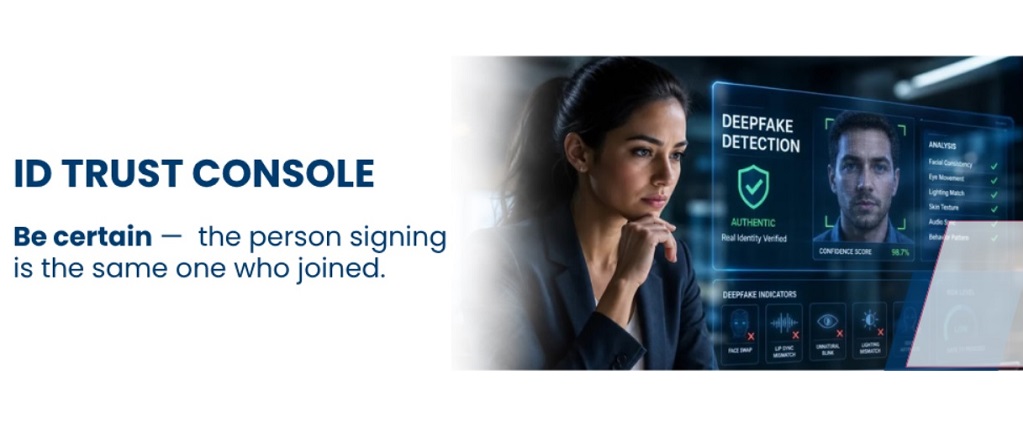
Repeated face matching and deepfake detection aim to stop fraudsters from replacing verified users during live signing sessions.
Secured Signing has introduced repeated facial identity checks and deepfake detection during Remote Online Notarization (RON) and live video signing sessions. They aim to detect if a verified user is replaced before a transaction is completed.
The new ID Trust Console compares the user’s live face with the identity verification result confirmed before the meeting to give the notary visibility into whether the person on screen continues to match the verified signer.
The console also displays the status of Secured Signing’s Realify deepfake detection system.
„The platform retests the user during the meeting, while the host can manually request an additional deepfake scan at any point. If a scan raises concern, the host receives an alert and can remove the user without restarting the session. The product addresses the gap in point-in-time identity verification. For instance, a fraudster could attempt to replace the verified user after the meeting begins by putting another individual in front of the camera or introducing synthetic video.” – according to biometricupdate.com.
“Verifying someone’s identity once, at the very start of a meeting, is no longer enough,” said Mike Eyal, CEO at Secured Signing. “The ID Trust Console was designed to give our customers regular, repeated confidence and compliance throughout the meeting, not just a single point-in-time check.”
How the ID Trust Console Works
The ID Trust Console appears as a live panel throughout any Video Signing and Remote Online Notarization meeting, giving hosts real-time visibility and control. The Console continuously performs three key checks:
. ID Verification — Confirms the signer’s government-issued ID and biometric face match the invited individual, regularly comparing live facial biometrics against verified records.
. Realify Deepfake Detection — Shows the pass/fail status of a live deepfake scan, confirming whether the person on screen is a genuine, real-time human.
. On-Demand Re-Testing — Lets the host manually trigger an additional deepfake test at any point during the session.
So, the platform automatically re-tests the signer throughout the meeting. If a scan raises a concern, the host is notified instantly and can remove the signer immediately, with no need to end or restart the session.
The checks provide two different forms of assurance. Facial comparison determines whether the person currently visible matches the verified identity, while Realify assesses whether the video represents a genuine live person.
The press release does not disclose how frequently the checks occur or whether every frame of the video is analyzed.
The console requires no additional configuration and is available within Secured Signing’s platform for RON and video signing meetings where pre-meeting identity verification or deepfake detection has already been completed.
Also, Secured Signing has expanded its Electronic Notarisation and In-Person Electronic Notarisation platform across England, Wales, Scotland and Ireland — giving notaries public a single, purpose-built solution to verify identity, combat deepfake fraud, and complete secure notarial acts with confidence, backed by a UK-based datacentre built around UK notary requirements.
No more travelling to London to get documents notarised. Notaries can now support clients wherever they are, office, home, car, anywhere, without compromising on compliance.
_________
Related articles:



Banking 4.0 Hackathon: EUDI Wallet Instant Credit – powered by Tremend


Dariusz Mazurkiewicz – CEO at BLIK Polish Payment Standard
Banking 4.0 – „how was the experience for you”
„To be honest I think that Sinaia, your conference, is much better then Davos.”
Many more interesting quotes in the video below: