
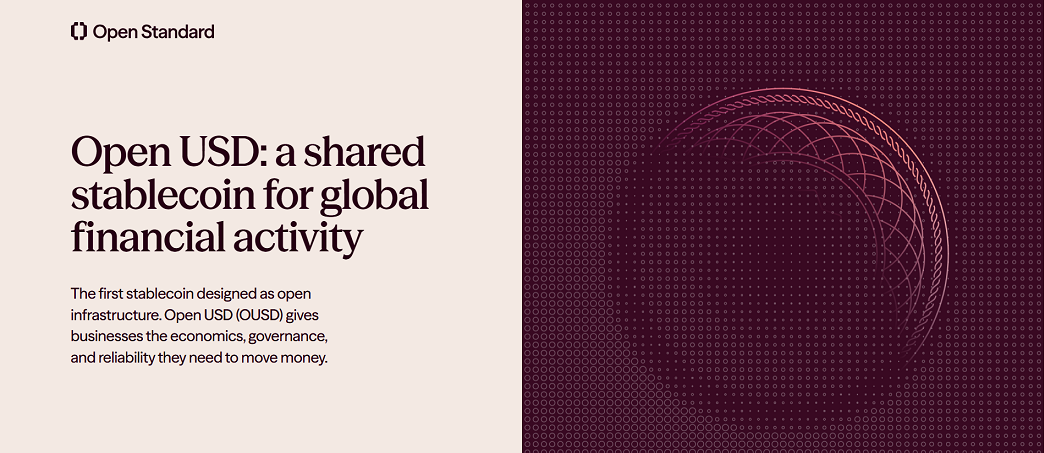
Stablecoins are being rapidly adopted for their speed, cost, and programmability, with transaction volume approaching that of the ACH network.1 At the same time, businesses still face significant hurdles: fees to mint and redeem most stablecoins are prohibitively expensive at larger volumes; companies aren’t always able to benefit from the revenues earned on the underlying reserves; and developers have little recourse if the roadmaps of third-party issuers do not meet their needs.
More than 140 companies joined a consortium called Open Standard to launch Open USD, or OUSD, a dollar-backed stablecoin. The companies include stakeholders from both traditional payments and crypto-native ecosystems like Visa, Mastercard, Stripe, American Express, Coinbase, BlackRock, Google Cloud, BNY, IBM, DoorDash and Fireblocks.
The OUSD token was designed around the economic principle of shared ownership instead of proprietary control and highlights an evolution across blockchain finance as the industry separates the economic value of money from the ownership of money.
Rather than concentrating reserve economics with a single issuer, Open USD will allow participating institutions to mint and redeem the token without volume limits while sharing reserve income across the network after operating costs.
According to pymnts.com, the OUSD initiative transforms the question across crypto from, “Which stablecoin wins?” to “Which network becomes the default financial infrastructure for global digital dollars?” If that transition takes hold, the stablecoin market will begin to resemble the internet itself, with open standards at the core and the greatest value accruing to the platforms, applications and networks built on top of them, rather than to the protocol alone.
Open USD introduces three key design principles:
. Build for scale. Businesses can mint and redeem Open USD at no cost and with no artificial limits on volume.
. Earn by default. Partners receive all of the earnings from Open USD’s reserves, less a small management fee to cover Open USD’s operational costs.
. Govern collaboratively. Open USD will be operated by Open Standard, an independent company with a board made up of Open USD’s partners, ensuring decisions are made for the collective interest, not a single entity.
„Existing stablecoins have great strengths, but to use them at scale, businesses need something that’s open, low-cost, high-throughput, broadly accessible, and aligned to their interests. We’re thrilled to bring together over 140 businesses to launch Open USD. It’s a stablecoin built for the internet economy, designed by the businesses growing it.” – said Zach Abrams, Founding CEO of Open Standard.
The OUSD consortium is also shifting stablecoin reserve income from an issuer-specific profit center into a network growth mechanism. Instead of spending heavily on customer acquisition or partnership incentives, the economics of the infrastructure itself encourage broader participation. The model resembles successful platform businesses in which participants capture value by helping expand the ecosystem rather than merely consuming its services.
After all, businesses are unlikely to build critical financial systems atop infrastructure whose governance remains uncertain or concentrated within a single commercial entity if credible alternatives exist. Open standards historically succeed not because they eliminate competition but because they relocate it.
Companies stop competing over ownership of the infrastructure itself and instead compete through products, services and applications built on top of that common foundation.
If this ultimately occurs across the digital asset space, the launch of Open Standard will be remembered less as the arrival of another digital dollar than as the moment the industry began competing over the operating system for programmable money rather than the currency itself.
Quotes
„By bringing stablecoins to our retail and corporate clients, we are fundamentally changing how money moves—making financial transactions frictionless and available 24/7.” – BBVA, Alicia Pertusa, Head of CIB Partnerships & Innovation.
„Fireblocks already settles a meaningful share of global stablecoin volume for banks, PSPs, and the world’s largest payment networks. Joining Open Standard is a natural extension of that role, and a real signal that the industry is consolidating around shared, regulated infrastructure rather than building it in silos.” – Fireblocks, Michael Shaulov, CEO.
„Businesses need a stablecoin designed to work at global, industrial scale. And not at the scale of the 2026 economy, but of the 2040 economy, with flurries of activity we can only begin to imagine. That’s why Open USD will be the default stablecoin for businesses running on Stripe; they are the ones shaping the next 15 years of economic growth.” – Stripe, Will Gaybrick, President of Technology and Business.
„In payments, scale only comes with trust. As stablecoins evolve, the focus must shift from speed to reliability, governance, and interoperability. Visa is bringing the same discipline, risk standards, and operational rigor we apply to our global network to Open USD, helping build the trust layer that allows stablecoins to operate confidently within the broader financial system.” – Visa, Jack Forestell, Chief Product and Strategy Officer.
„Stablecoins become much more powerful for merchants when the ecosystem builds around them together. That’s what makes Shopify’s participation in Open Standard compelling: we can help shape how it works for small businesses, alongside other platform leaders driving adoption. The result is a stronger foundation for more choice at checkout, more efficient money movement, and more opportunity for entrepreneurs around the world as stablecoin becomes part of everyday commerce.” – Shopify, Rohit Mishra, VP Product, Payments, Tax, and Cross-Border.
„Stablecoins are the most important thing happening in payments right now, and we’re committed to giving our customers access to the best options available – including Open USD and beyond. The more great infrastructure this industry builds together, the faster we close the gap between what payments are today and what they should be.” – Coinbase, Shan Aggarwal, Chief Business Officer.
____________
“State of Crypto 2025: The year crypto went mainstream.” a16zcrypto.com/posts/article/state-of-crypto-report-2025/ ↩
Banking 4.0 – „how was the experience for you”
„To be honest I think that Sinaia, your conference, is much better then Davos.”
Many more interesting quotes in the video below: