World Bank report on digital wallets: a new paradigm, converge of user-centric digital identity, data sharing and payments
Digital wallets complement existing digital identity and data-sharing approaches, offering a scalable and interoperable infrastructure upon which future capabilities can be built. By placing users at the center of data-sharing decisions, grounding trust in cryptographic verification, and aligning implementation to emerging global standards, digital wallets provide a powerful platform for modernizing service delivery and enabling more secure, privacy-preserving interactions across the digital economy.
Digital wallets enable a move from siloed, tightly coupled systems toward modular, user-centric, and standards-based architectures. Traditional digital ID approaches bind identity attributes and authentication mechanisms into a single solution, leaving other data relevant for service delivery to be shared through other channels. Digital wallets combine digital ID functions with reusable verifiable credentials held and controlled by the user. This decoupling enables new flexibility: credentials can be issued by many authoritative entities, stored securely in interoperable wallets, and selectively disclosed to a wide range of service providers without requiring bespoke integrations or unnecessary data sharing.
Digital wallets mark a paradigm shift in how digital public infrastructure (DPI) like digital identity, data sharing, electronic signatures, and payments can be organized. In earlier generations, each of these domains evolved in its own silo: digital ID systems tightly coupled identity attributes and authentication mechanisms; data sharing relied on point-to-point integrations between backend systems; electronic signatures often depended on specialized devices and readers; and the mechanisms used to authorize payments ran on completely parallel infrastructure.
Although all of these solutions have been critical to growing the digital economy to where it is today, they nonetheless had a number of limitations. In many cases, previous generations of digital ID, data sharing and electronic signature infrastructure were difficult to use, hard to scale, and they were rarely fully integrated into the channels that people actually used to access services.
Lessons from these earlier approaches, combined with the widespread availability of smartphones and the emergence of a new set of open standards, have enabled the emergence of a new paradigm based on digital wallets. Digital wallets allow identity and other credentials to be issued by the institutions that already manage them in the real world, while providing a common, interoperable environment where those credentials can be stored, combined, and used alongside signing and payment-related functions in smoother, end-to-end workflows.
„The World Bank published a new note on digital wallets, and the framing is different from most of what’s out there. It treats wallets as infrastructure, not an app feature. The core idea: decouple the credential from the wallet that holds it. Right now, most digital ID systems bundle registration, authentication, and data into one provider. The wallet model splits this apart. A passport office, university, or tax authority issues a verifiable credential into a wallet the user controls, and any verifier can check it cryptographically without a bilateral integration.” – said Sam Boboev, founder & CEO Fintech Wrap Up.
This document provides a conceptual and architectural framework for understanding digital wallets, verifiable credentials, and their role in transforming digital identity, data sharing, electronic signing, and digital payments. It is intended primarily for government decision-makers and practitioners seeking to design, regulate, or oversee wallet ecosystems, although many concepts are equally relevant for private-sector participants of these ecosystems—including financial institutions, trust service providers, and technology platforms.
This paper focuses on how wallets work, what is new about them, and how they change digital identity, data sharing, electronic signatures, and payments. It also highlights the risks and challenges that implementers must address as these ecosystems grow.
According to Sam Boboev, a few things stood out:
. Selective disclosure is the real unlock. A user can prove „I’m over 18” or „I’ve paid my taxes” without revealing a birthday or income. That’s a genuine privacy upgrade over handing over a full ID card.
. Payments are moving slower than identity here. Visa, Mastercard, UPI, and Pix run on decades of liability frameworks and merchant networks, so they’re not converging on wallet standards as fast as identity and data sharing are. Apple Wallet shows both worlds in one interface, but the payment and credential data flows underneath are still separate systems.
. Consent fatigue is flagged as a real risk, not a footnote. Giving users control only works if they’re not asked to make dozens of micro-decisions a day.
Many real-world implementations already combine identity with electronic signatures or integrate wallets into government service apps. Regional initiatives like the European Union’s Digital Identity (EUDI) Framework are providing a cross-border trust framework allowing international mutual recognition of digital identity and electronic signatures across borders, leveraging new and emerging standards.
Although the degree and pace of convergence will vary by domain, it is clear that these technologies are gradually moving closer together and shaping one another. The current generation of digital wallets are becoming multifunctional user-centric data-sharing platforms, capable of managing and sharing a wide range of identity credentials as well as other personal data related to accessing services.
More details here




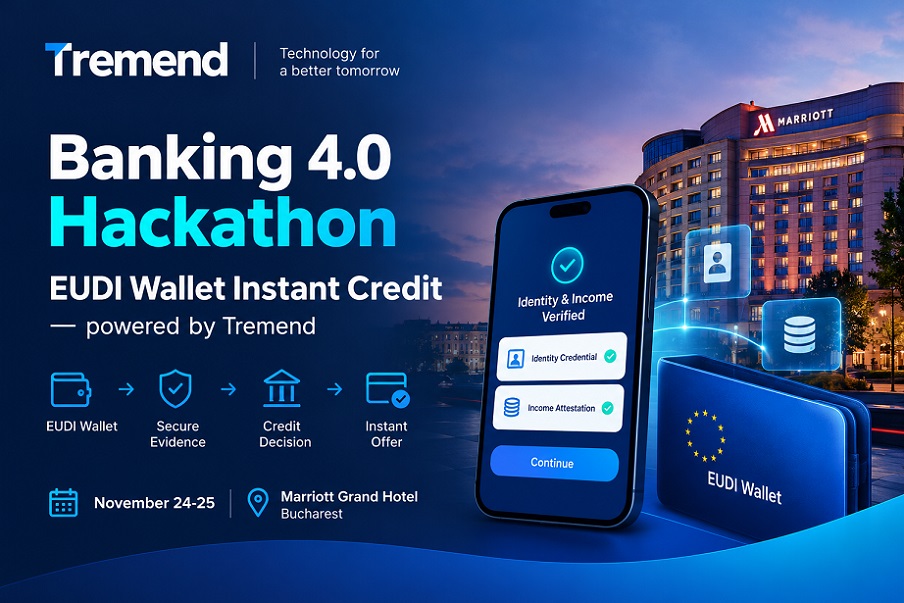
Banking 4.0 Hackathon: EUDI Wallet Instant Credit – powered by Tremend


Dariusz Mazurkiewicz – CEO at BLIK Polish Payment Standard
Banking 4.0 – „how was the experience for you”
„To be honest I think that Sinaia, your conference, is much better then Davos.”
Many more interesting quotes in the video below: