
The Swedish central bank is urging consumers to horde a week’s worth of cash in case of disruption to payment services during the volatile climate.
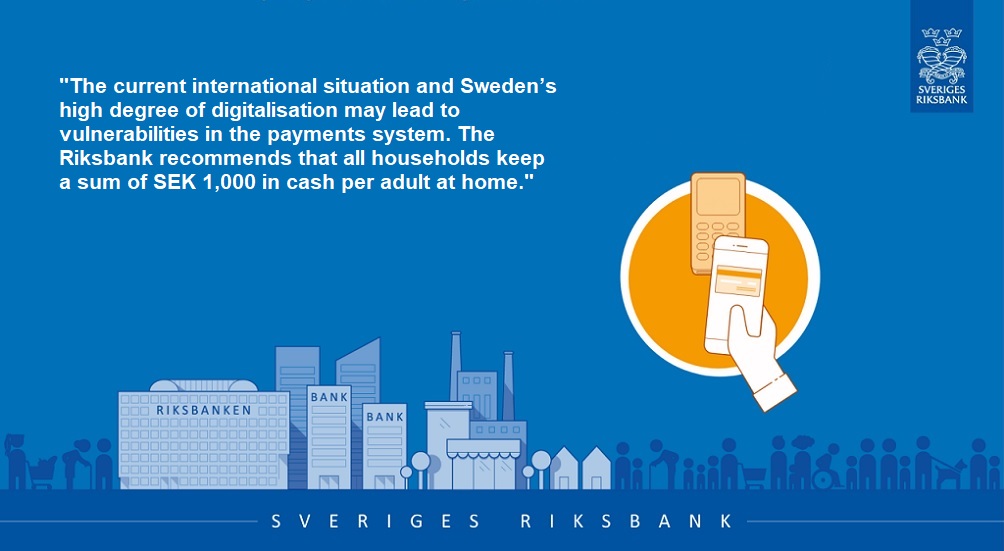
The current international situation and Sweden’s high degree of digitalisation may lead to vulnerabilities in the payments system. „It is therefore important for the general public to ensure that they have different ways to pay, such as cash, cards and access to payment services via mobile phones.” – said Sweden Central Bank in a press release.
The general public is an important part of Sweden’s total defence and central to strengthening national preparedness in the payments market. Having access to different payment methods improves the public’s ability to make payments in the event of temporary disruptions, crises and, in the worst case, war.
SEK 1,000 in cash per adult
The Riksbank recommends that all households keep a sum of SEK 1,000 in cash per adult at home. This amount should be seen as a benchmark and is intended to cover a week’s worth of essential purchases. Households may need more or less cash at hand, depending on the number of people in the household or the specific needs of the household. Where possible, households are advised to hold cash in several different denominations. The general public is also encouraged to use cash at regular intervals during normal times to keep the cash systems running.
Cards from different card networks
Households are encouraged to have access to at least two cards from different card networks, such as Visa and Mastercard. This means that the possibility to pay with one type of card can be maintained even if disruptions arise for another card.
Access to payment service via mobile phone, such as Swish
Mobile phone payment services such as Swish use a different underlying infrastructure compared to card payments. If card payments do not work, it is possible that Swish will work. The general public is therefore advised to secure their payment options by having access to this.
Physical cards and PINs should be easily accessible
Those who normally use integrated card services on their mobile phones, such as Apple Pay and Google Pay, should also have their physical cards available in case their mobile phone discharges or stops working. The physical card’s chip can also be used to make offline payments in case of interruptions.
____________
Related content
Consultation: New regulations to safeguard payments in crisis and war – The Riksbank proposes new preparedness regulations for companies that are of particular importance for the execution of payments. The proposal means that more companies should be covered by the Riksbank’s regulations and that the requirements relating to companies’ planning and preparation for a state of heightened alert are developed and made more concrete. The aim of the new regulations is to ensure that the public can make payments even in times of crisis and war.





Banking 4.0 – „how was the experience for you”
„To be honest I think that Sinaia, your conference, is much better then Davos.”
Many more interesting quotes in the video below: