Stablecoins have grown from less than USD 10 billion six years ago to more than USD 300 billion today. They are overwhelmingly denominated in US dollars, and nearly 90% of the market is controlled by two issuers – Tether and Circle – based in El Salvador and the United States, respectively.
Speech by Christine Lagarde – President of the ECB, at the Banco de España LatAm Economic Forum in Roda de Bará, Spain
As stablecoin adoption has expanded and their links to the real financial system are deepening, the risks they pose have come firmly into focus, especially as regards financial stability. These concerns have been particularly acute in parts of Latin America and Africa, but they are now firmly part of the policy debate in advanced economies as well.
Europe was early to recognise this. The Markets in Crypto-Assets Regulation (MiCAR) brought stablecoins within the regulatory perimeter in 2024, ahead of developments elsewhere, aiming to contain these risks and safeguard the integrity of the financial system.
In the United States, however, the approach has taken a broader turn. The GENIUS Act is not just a consumer protection and financial stability measure. The US Administration explicitly describes it as a tool to ensure “the continued global dominance of the U.S. dollar” and to cement demand for US Treasuries.The terms of the debate have shifted with it. It is no longer about whether stablecoins should exist, but whether jurisdictions can afford to be without them.
The growing argument is that to remain relevant, Europe must respond by promoting euro-denominated stablecoins of its own. Otherwise, it faces a future of digital dollarisation and a loss of monetary sovereignty.
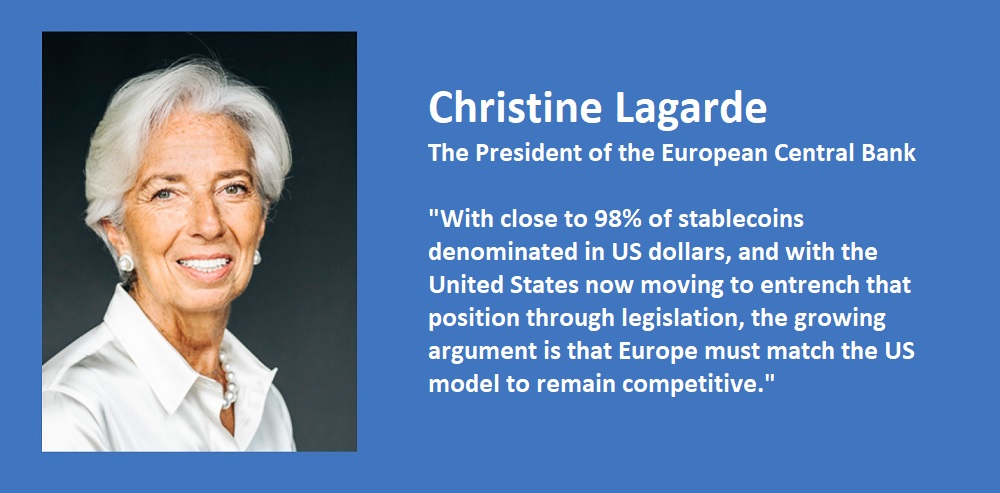
With close to 98% of stablecoins denominated in US dollars, and with the United States now moving to entrench that position through legislation, the growing argument is that Europe must match the US model to remain competitive.
The case for promoting euro-denominated stablecoins is far weaker than it appears. And a more fundamental question comes into view: do we actually need stablecoins to obtain the benefits they are said to provide? Or are we mistaking the instrument for the outcome, when what matters is the architecture underpinning which other instruments can safely emerge?
Well, depends on the function.
For the monetary function, the foundations have to come first: deeper and more integrated capital markets, and a safe asset. Stablecoins cannot build those foundations for us, and without them, euro-denominated stablecoins could risk amplifying the very vulnerabilities we are trying to overcome.
For the settlement function, the key question is less about which private instrument will prevail – be it stablecoins, tokenised deposits or a yet-to-emerge alternative – and more about whether a common anchor is in place. That’s why we are placing central bank money at the heart of this new infrastructure.
More details here:
Stablecoins and the future of money: separating functions from instruments







Banking 4.0 – „how was the experience for you”
„To be honest I think that Sinaia, your conference, is much better then Davos.”
Many more interesting quotes in the video below: