Let’s allow FIDA (Financial Data Access Framework) to fail
The European debate on open finance is still conducted as if regulation were the only serious mechanism capable of bringing this market into existence. This assumption is convenient, especially for those who prefer to wait. It allows the industry to discuss principles, produce position papers, seek clarity, and postpone investment until the final legal text is available. But it may also be wrong.
An article by Maciej Kostro – Author of The Invisible Machine | Open Finance Strategist | API Standardisation Expert | Service Owner at ING
FIDA was intended to create a structured framework for accessing financial data across Europe. In its basic construction, the idea is sound. The market needs common roles, common rules, common data-sharing arrangements, liability allocation, customer permissions, and a basis for interoperability. However, the fact that an idea is sound does not mean that it will survive the legislative process or the resistance of the market actors who would have to pay for it.
There is a realistic scenario in which FIDA is delayed for years, reduced to a much weaker instrument, or never introduced in a form capable of changing the market. This would not happen because open finance lacks economic or social logic, but because it interferes with too many particular interests.
Data holders are not naturally inclined to finance infrastructure that may weaken their current position. They hold the data, carry regulatory risk, have established customer relationships, and have no obvious reason to make life easier for companies that may compete with them at the customer interface. Data users, on the other hand, want broad access, good quality, low cost, and fast implementation. They often support openness in principle, but not always the price required to build and maintain the common layer. Regulators expect competition, consumer benefit, and market integration, but the cost of the machinery needed to achieve these goals is often underestimated.
Consumers and companies would probably benefit from better access to their own financial data. But they are not organised as a lobby. They will not sit in working groups for years to defend the architecture of an open finance market. They will simply use whatever works.
This is the problem of the common good. A well-governed open finance ecosystem may benefit the market as a whole, but each individual participant may have a rational reason to wait, reduce its exposure, protect its position, or hope that someone else will make the first large investment.
We have seen this before. PSD2 created a legal right of access, but it did not create a fully functioning European open banking market. Many institutions treated it as a compliance exercise. SPAA then offered a more commercial, scheme-based path beyond PSD2, including the possibility of premium services and compensation. The market response was cautious at best. This should be treated as an important signal. The industry often speaks positively about cooperation, but it hesitates when cooperation requires real money, real governance, and real loss of unilateral control.
FIDA may fail because the market may lack the will to build the common infrastructure on which the concept depends. But, of course, this does not mean that open finance will fail.
Open finance, understood in a simple, practical sense as access to personal and corporate financial data from multiple sources, is likely to emerge anyway. It may just arrive through another door. Not through a carefully constructed European regulation, but through AI agents acting on behalf of customers and companies.
These agents will need financial data. They will need account information, loan data, investment data, pension data, insurance data, invoices, tax information, cash-flow history, and payment capabilities. A person will not ask for “open finance”. A person will ask an agent to compare mortgage options, prepare a credit application, explain pension choices, review insurance coverage, manage household liquidity, or find unnecessary costs. A company will ask an agent to monitor cash flow, prepare financing documentation, reconcile accounts, compare banking offers, or analyse payment behaviour.
For such services to work well, the agent needs access to data. If the regulated European financial sector does not create a trusted, common way to provide that access, other actors will seek less orderly routes. Large technology companies and AI-native firms will not wait until Europe agrees on the perfect compromise. They will build the customer layer first. They will use direct integrations where possible, user-permissioned access where available, document upload where needed, inference where data is missing, and contractual arrangements where regulation is absent.
The result may still be called open finance, but it will not be the open finance imagined in the regulatory debate. It may be fragmented, contractual, opaque, and controlled by those who own the interface through which customers make decisions. Financial institutions may retain licences, balance sheets, compliance departments, and operational burdens, while the interpretation of the customer’s financial life moves elsewhere.
This is the uncomfortable point. Banks, insurers, investment firms and other financial institutions may continue to hold the data, but the party that explains the data, recommends the next action, and initiates the customer’s decision may be an AI agent supplied by someone else. This is why the market must organise itself.
The absence of FIDA would not remove the need for governance. In my view, it would make governance more urgent. Without a common scheme, the market will default to bilateral agreements, inconsistent interfaces, uneven data quality, uncertain consent models, unclear liability, weak dispute procedures, and no common operational language. This may be acceptable for isolated commercial experiments. It is not a stable basis for a European open finance market.
A scheme is the market’s method of creating order before, beside, or sometimes instead of regulation. It allows participants to agree who may join, what data or services are in scope, what rules apply, what technical standards are used, how permissions are managed, how liability is allocated, how participants are certified, how fees are calculated, and how the arrangement changes over time. It converts many separate interests into a functioning market structure.
This is also why the scheme-related part of FIDA remains useful even if FIDA itself does not survive. The relevant provisions are generic enough to serve as a model for other data-sharing arrangements. They describe the type of questions that any serious scheme must answer. In that sense, FIDA is less important as a legislative destiny and more useful as a design reference.
The same is true of SPAA. SPAA demonstrated that a scheme can be used not only to satisfy regulatory expectations, but also to build a commercial layer above the regulatory minimum. It showed the importance of roles, a rulebook, premium services, compensation, governance and a structured dialogue between different sides of the market. FIDA applies some of this logic to a broader financial data context. But the logic itself is not dependent on FIDA.
This is the point of Scheme²
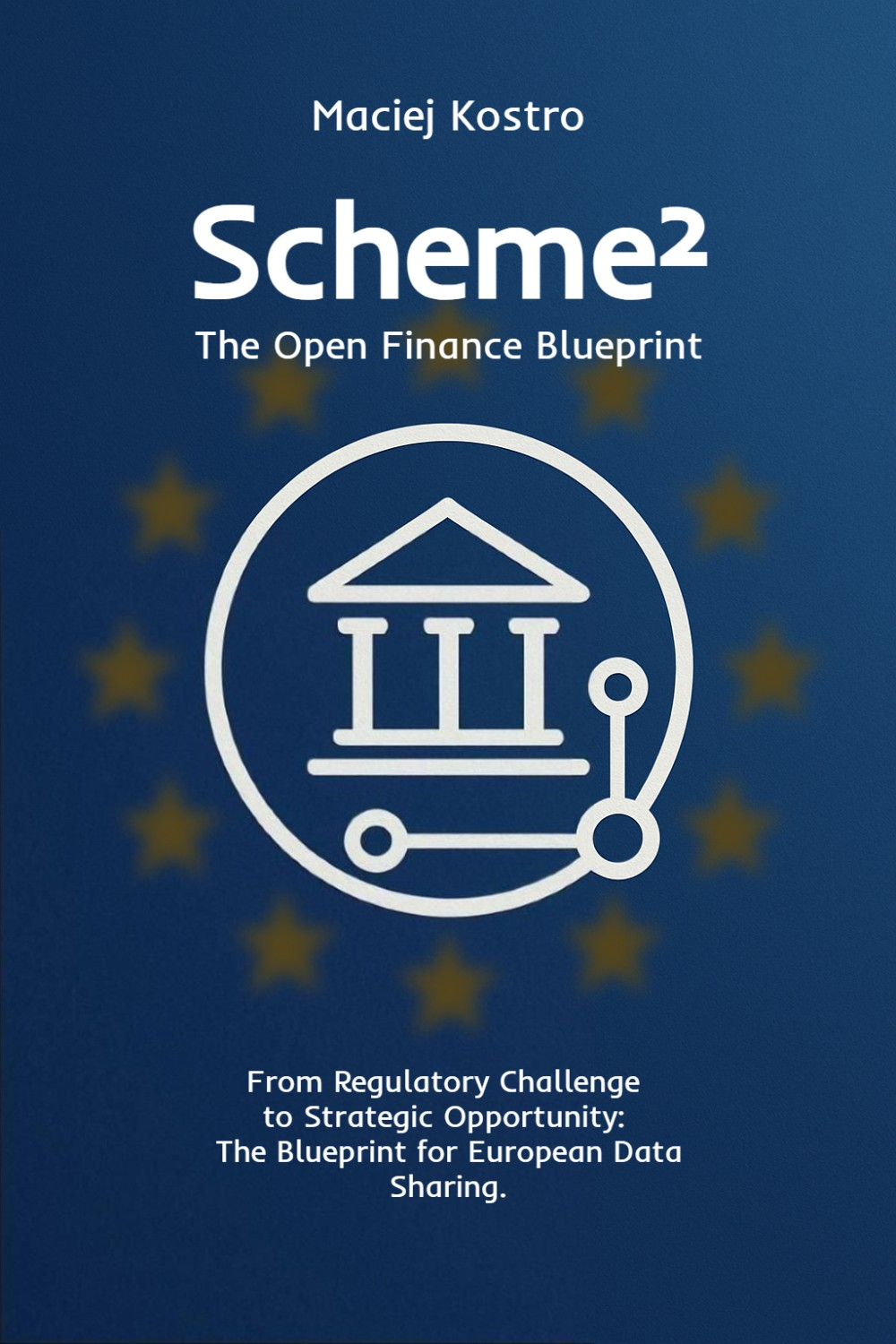
Scheme² uses FIDA as a model because it provides a concrete, rich example of a future financial data-sharing framework. But the methodology is not limited to FIDA. It is a method for creating schemes. It can be applied to mandatory schemes, voluntary schemes, national schemes, European schemes, payment-related schemes, AI-related data access schemes, sectoral schemes, and arrangements that will appear before regulators have found a name for them.
If FIDA fails, who will define open finance in Europe? The financial industry, through common schemes? Regulators, perhaps later and under pressure? Or AI platforms that build the customer interface first and ask for forgiveness, clarification, or market acceptance afterwards?
Waiting may feel safe, but it is not neutral. Each year of delay gives more room to actors who do not need the European financial sector to reach a common position. Each failed attempt at collective investment strengthens the case for private control of the customer layer. Each abandoned scheme makes the market more dependent on bilateral deals and external platforms.
FIDA may fail. But not the open finance. If Europe wants any serious degree of control over how financial data is accessed, interpreted and used by AI agents, the market must organise itself. The best available instrument for doing so is a scheme.
And this is why I wrote Scheme².






Dariusz Mazurkiewicz – CEO at BLIK Polish Payment Standard
Banking 4.0 – „how was the experience for you”
„To be honest I think that Sinaia, your conference, is much better then Davos.”
Many more interesting quotes in the video below: