Amid the conflict in Iran, the complex security landscape, and ongoing uncertainty in the Middle East, travel plans of European and international tourists are shifting significantly. According to the latest data from Global Research Group analysts within Global Payments, more than 2 million tourists could choose safer destinations in Central Europe this year, instead of traveling to Asia or the Middle East.
Romania could attract an additional 150,000 tourists, generating approximately EUR 40 million in
revenue for hotels and restaurants. In this context, Global Payments Romania expects an increase
in demand for cashless payment solutions in tourist destinations, as these are increasingly preferred by modern travelers.


Additional tourist wave could generate nearly EUR 2 billion in Central Europe
Since the beginning of the conflict in Iran, over 52,000 flights to Middle Eastern destinations have been canceled, prompting many European tourists to seek safer alternatives for their holidays. The region is estimated to lose between 23 and 38 million visitors in 2026, with a potential impact of up to USD 56 billion in tourism revenue (1) . A portion of these tourists—approximately 8–12 million—are now reshaping their travel plans and choosing destinations in Europe instead (2) .
Central Europe is emerging as one of the main beneficiaries of these shifts in tourism. The six countries analyzed—Slovakia, the Czech Republic, Austria, Hungary, Romania, and Croatia—attracted 125 million tourists last year, and Global Payments estimates they could receive an additional 1.1–2.5 million visitors in 2026 if geopolitical instability persists.
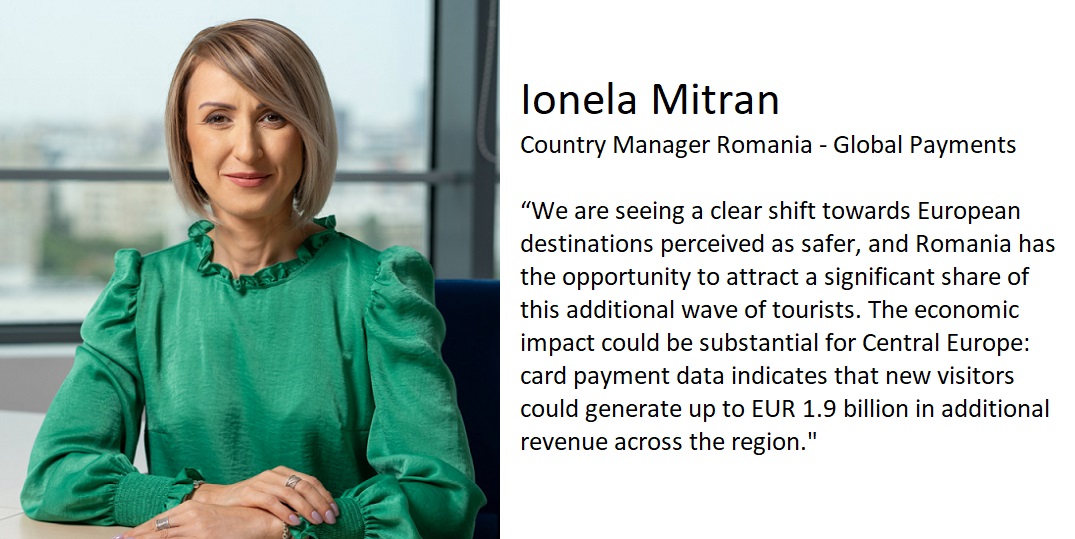
“We are seeing a clear shift towards European destinations perceived as safer, and Romania has the opportunity to attract a significant share of this additional wave of tourists. The economic impact could be substantial for Central Europe: card payment data indicates that new visitors could generate up to EUR
1.9 billion in additional revenue across the region. In this context, it is essential for the local industry—especially hotels and restaurants – to be prepared to meet tourists’ expectations, including by offering seamless, secure, and cashless payment experiences,” said Ionela Mitran, Country Manager Global Payments Romania.
How much will the new tourists spend in Central Europe
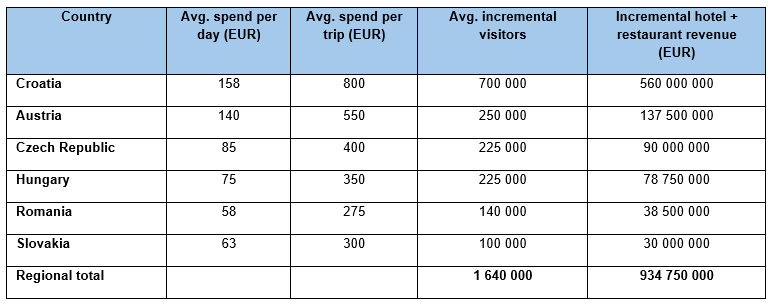
According to estimates by the Global Research Group within Global Payments, Romania could attract approximately 150,000 additional tourists this year. Key destinations include the Black Sea coast, as well as major cities such as Bucharest, Brașov, Cluj, and Sibiu. Most of these tourists are expected to come from Austria and Germany, where more travelers are opting out of long-haul trips in favor of closer and more affordable destinations such as Romania or Slovakia.
At the same time, tourists from France, Belgium, the Netherlands, and the Nordic countries (Denmark, Sweden, Norway) are also reshaping their travel plans, shifting from Mediterranean or long-distance destinations to safer countries within the Schengen area.
In Romania, the average length of stay is approximately 3–4 days, similar to Austria, the Czech Republic, Slovakia, and Hungary. Croatia is expected to benefit the most from the new tourist flows, with an average stay of five nights or more. This additional wave could have a significant impact on Romania’s hospitality industry, generating around EUR 40 million in spending. Among the countries with the highest estimated tourism spending impact are Croatia, with over EUR 550 million, and Austria, with nearly EUR 140 million.
In a European comparison, French and German tourists are the highest spenders during their holidays. According to Eurostat, they generate nearly half of the tourism revenues in the European Union. They are followed by tourists from Belgium, the Netherlands, Austria, and the Scandinavian countries.
Demand for cashless payment solutions is on the rise
As the number of foreign visitors to Romania increases, the need for fast, secure, and convenient payment methods becomes essential. According to estimates, the POS terminal market in the hospitality sector across Central Europe is expected to grow by 6–8%. Hotels and guesthouses will need to process a growing number of international transactions via cards and mobile wallets. Currently, it is crucial to accept contactless payments, integrate with booking systems for payment pre-authorizations, and adopt transparent pricing models.
“Global Payments data shows an accelerated shift in consumer behavior: in just two years, cashless
payments have become the standard in tourist areas. This is no longer a competitive advantage, but a
necessity for businesses and entrepreneurs. In the winter season 2025–2026 alone, more than two
million electronic transactions were recorded in restaurants and hotels in Romania through Global
Payments terminals,” said Ionela Mitran, Country Manager Global Payments Romania.
During the winter season (December 2025 – February 2026), tourists spent over RON 260 million through digital payments in hotels and restaurants in Romania, according to Global Payments data. Compared to the winter season 2023–2024, the value of cashless spending increased significantly: +51% for food services and +31% for accommodation.
Data from the National Bank of Romania (BNR) shows that the total value of payments made with cards issued in Romania reached approximately RON 189 billion in the first half of 2025, up 19% year-on-year, while the number of transactions exceeded 1.5 billion (+30%) 3 .
_____________
1 Source: Oxford Economics / Tourism Economics (2026), Tourism Impacts in the Middle East from the Iran War, March 2026.
2 Source: Derived from Eurostat and Oxford Economics / Morgan Stanley estimates for 2026.
3 Source: National Bank of Romania (BNR), H1/2025: https://www.bnr.ro/1947-statistica-plati






Banking 4.0 – „how was the experience for you”
„To be honest I think that Sinaia, your conference, is much better then Davos.”
Many more interesting quotes in the video below: