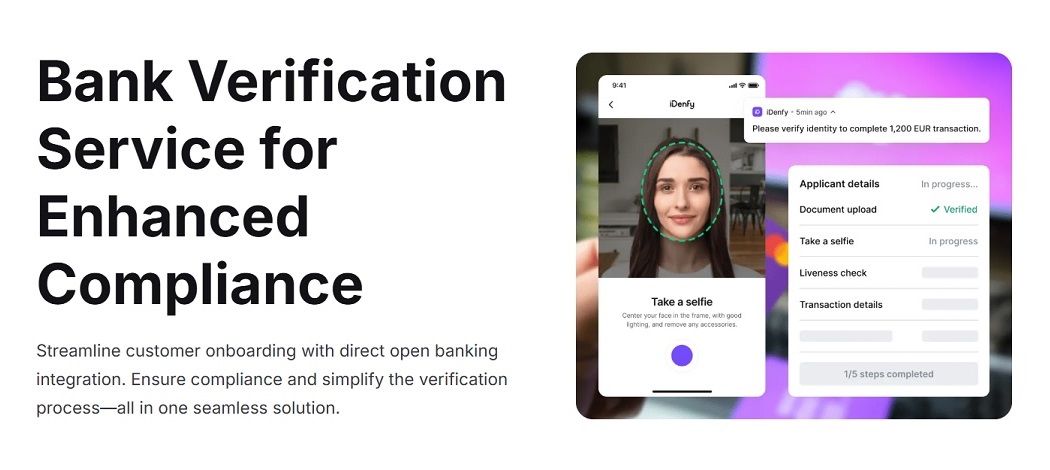
Businesses will be able to manage bank card verifications directly from a dedicated iDenfy’s dashboard, create verification requests, and review verification results in a centralized view
iDenfy, the global identity verification, compliance, and fraud prevention solution platform, has announced the launch of a Bank Card Verification platform within its software dashboard. This new upgrade gives iDenfy’s partners the ability to manage bank card verifications on their own, separately from iDenfy’s core identity verification flow metrics, while still relying on the same level of security.

„As a result, partners can create verification requests, generate verification links as well as tokens, send invitations by email, and review results from a centralized view, all supported by their own API endpoints, configurations, permissions, and even billing.” – according to the press release.
Bank account verification is a process that confirms the validity of a bank account and whether it belongs to the person who claims its ownership. It is commonly used for online bank payments to reduce the risk of fraud. Rather than treating card verification as a feature bundled inside a broader onboarding flow, iDenfy has built it out with its own API endpoints, product configurations, permission settings, and billing options, so partners that only need card verification are not required to adopt the full identity verification stack to access it.
According to Domantas Ciulde, the CEO of iDenfy, the update reflects a broader repetitive pattern the company has noticed among partners that operate across regulated industries.
“Not every partner that needs to confirm a bank card requires a full identity verification flow running alongside it. We kept hearing that request, so we built bank card verification as its own product, with centralised view and configurations, rather than an added feature, so partners can pick it up on its own terms,” said Domantas Ciulde.
When a business enables the bank card verification flow, the end user simply receives a verification link by invitation; the end user has to verify the bank card by choosing and verifying the card ownership in two ways: either by capturing it with the smartphone as well as any other device such as an iPad or laptop integrated camera, or uploading a card confirmation document that verifies the owner.
As an option, users can also be asked to enter the last 4 digits of their bank card to ensure greater accuracy. It is important to note that only the card number and the name are read, and the card verification value, also known as CVV, is not captured or stored because it is classified as sensitive authentication data. iDenfy strictly complies with regulations and protects users from database breach attacks and fraud exposure.
Once that login succeeds, iDenfy extracts the relevant authentication data and passes it to the client in real time through API and SDK, without needing to do any further action.
Validated banking data reduces the risk of identity fraud, including account takeovers and the misuse of stolen credentials. By confirming payment ownership and transaction history rather than relying on a document that can be forged or reused. It also helps businesses to stay aligned with PSD2 European Union rules that make online payments safe, as well as anti-money laundering and counter terrorist financing frameworks. Newer requirements such as the Instant Payments Regulation (IPR) also push institutions toward faster and more verifiable ways to confirm who actually controls an account.
Because the data comes directly from the bank rather than a submitted document, due diligence checks move faster too; With providers like iDenfy, bank accounts can often be verified instantly using real-time APIs. Older methods like micro-deposits might take a few days, but modern systems give compliance teams real-time, instant access to validate banking data across 29 countries from more than 2,500 banks in Europe.
Once a user provides needed data, businesses can automatically retrieve identity details such as name, surname, IBAN, and bank information directly from the account, cross-check those details against account ownership, and use that data solely for verification purposes without storing sensitive banking information beyond what verification requires.
“Centralizing verification requests and results in one dashboard view might sound like a small operational detail, but for partners processing card verifications at scale, it removes a lot of manual tracking that used to happen outside our platform,” added Domantas Ciulde, the CEO of iDenfy.
Both the Bank Card Verification page and the expanded open banking capabilities are available now to iDenfy partners, who can integrate through API, iFrame, or mobile SDK, with support available from iDenfy’s team for a smooth setup and no additional coding required to activate the dashboard module itself.
iDenfy is an identity verification, business verification, and AML compliance platform trusted by over 1,000 companies worldwide. The platform combines AI-powered document verification, biometric liveness detection, AML screening, and KYB solutions into a single integration. iDenfy supports 200+ countries and territories, holds ISO/IEC 27001:2022 certification, and is SOC 2 Type II audited.






Banking 4.0 – „how was the experience for you”
„To be honest I think that Sinaia, your conference, is much better then Davos.”
Many more interesting quotes in the video below: