Corporate lending: Avant Credit granted €4 million in financing during the first ten months of the year. The company aims to reach a loan portfolio of €6 million by the end of 2026.
The company aims to reach a loan portfolio of €6 million by the end of 2026, in a market where corporate lending, measured as a share of GDP, remains less than half the EU average.
Part of the Czech APS Holding Group, the non-bank financial institution is currently assessing transactions worth approximately €20 million, in a market where corporate lending as a share of GDP stands at less than half the EU average.
Avant Credit IFN has provided a total of €4 million in financing since the beginning of the year, following the repositioning of its business towards corporate lending. The company currently has a pipeline of approximately €20 million and is targeting a loan portfolio of €6 million by the end of 2026.
The company primarily serves SMEs and mid-market businesses with annual revenues ranging from €1 million to €20 million, focusing on the real estate and energy sectors, while also assessing opportunities in IT, construction and transportation.
Financing starts at approximately €100,000, with an average loan size of around €500,000. Recent transactions include a €1.3 million working capital facility granted to an international transportation company.
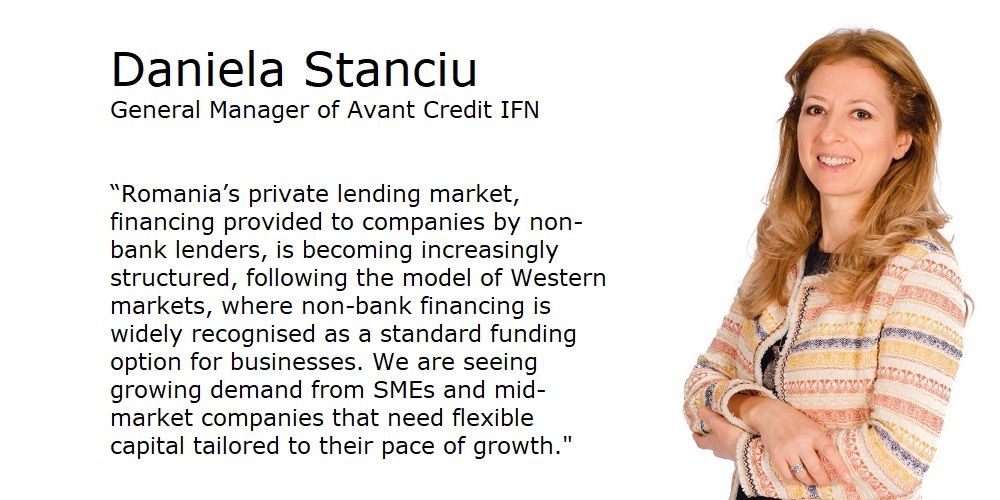
“Romania’s private lending market – financing provided to companies by non-bank lenders, such as non-bank financial institutions and private credit funds – is becoming increasingly structured, following the model of Western markets, where non-bank financing is widely recognised as a standard funding option for businesses. We are seeing growing demand from SMEs and mid-market companies that need flexible capital tailored to their pace of growth, whether for working capital, acquisitions in consolidating industries, or real estate and energy projects. Our current pipeline confirms the need for such solutions and supports our portfolio growth objectives,” said Daniela Stanciu, General Manager of Avant Credit IFN.
Corporate lending in Romania remains well below the European average
Romania has the lowest level of non-government credit relative to GDP in the European Union, at 22% as of the end of March 2026, compared with the EU average of 66%, according to the Financial Stability Report published by the National Bank of Romania in June 2026.
Against this backdrop, non-bank financial institutions are playing an increasingly important role in financing the economy. Lending by non-bank financial institutions to non-financial corporations increased by 12.5% in 2025, reaching RON 49.8 billion, according to the National Bank of Romania’s Annual Report. However, approximately two-thirds of this amount consists of leasing, indicating that direct lending to companies by non-bank lenders is still at an early stage of development.
For Avant Credit, this gap points to significant growth potential for financing solutions that complement traditional bank lending, particularly in situations where the timing of a business opportunity does not align with that of conventional funding sources.
“We see young companies in Romania, businesses emerging from restructuring processes, and fast-growing companies that need to be assessed based on their development potential. We also work with companies that have secured EU funding, are awaiting VAT refunds or have outstanding receivables from contractual relationships with the public sector, but need access to funds sooner than these payments are expected to arrive. We offer these companies a fast response, repayment structures tailored to their cash flows, and the backing of a financial group with more than 22 years of experience across Europe,” added Daniela Stanciu.







Dariusz Mazurkiewicz – CEO at BLIK Polish Payment Standard
Banking 4.0 – „how was the experience for you”
„To be honest I think that Sinaia, your conference, is much better then Davos.”
Many more interesting quotes in the video below: