BIS white papers: the impact of stablecoins on the international monetary and financial system
This paper examines how stablecoins could affect the international role of currencies, with particular emphasis on implications for emerging market and developing economies (EMDEs).
Stablecoins are privately issued digital tokens designed to maintain a stable value relative to a reference asset, most commonly a sovereign currency. Since their emergence in 2014, they have evolved from niche instruments serving cryptocurrency traders to a global phenomenon with market capitalisations exceeding $300 billion in 2026.
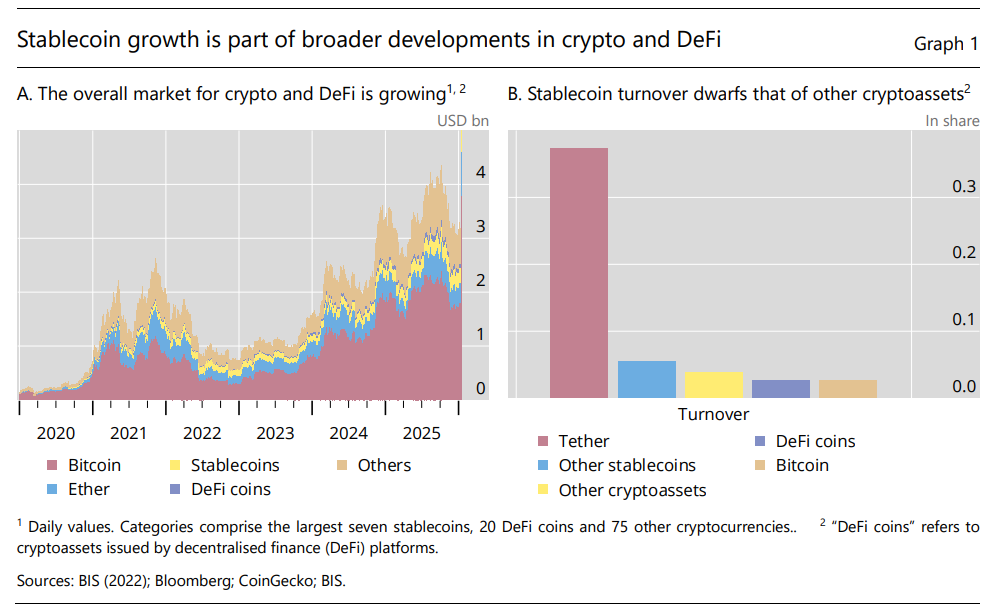
At present, the vast majority of stablecoin activity remains tied to cryptocurrency trading, with adjusted transaction volumes dominated by non-retail participants. Yet the trajectory of adoption may matter more than today’s baseline.
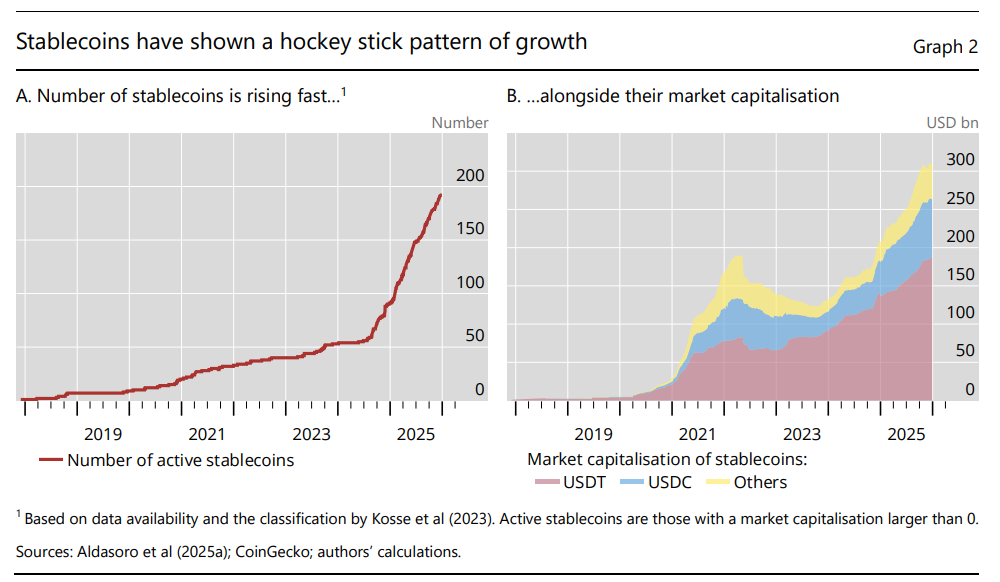
While stablecoins remain a small fraction of the broader financial system, their growth trajectory has been striking. The number of active stablecoins nearly quadrupled following the US presidential elections in November 2024, and their market capitalisation has exhibited the characteristic “hockey stick” pattern of exponential adoption.
Widespread use of stablecoins could have an important impact on the international monetary and financial system, particularly for emerging market and developing economies (EMDEs). „Using the framework of international currency functions to analyse their effect, we argue that stablecoins are most likely to affect private sector store of value and medium of exchange roles, particularly in economies facing macroeconomic instability.” – according to the authors of the latest BIS Papers related to stablecoin impact on the financial system.
Given that approximately 98% of stablecoins’ value is dollar-denominated, they are likely to initially reinforce existing currency hierarchies.
Future stablecoin adoption – three scenarios
The authors develop three scenarios to explore the range of potential outcomes that span from marginal to transformative impacts. In the first scenario, which we term “niche adoption”, stablecoins remain primarily instruments for on-chain trading within cryptocurrency ecosystems, with limited penetration into real-economy transactions. Capital flow leakage occurs but remains small relative to overall balance
of payments flows, and monetary authorities retain meaningful policy autonomy.
The second scenario, “digital dollarisation”, envisions rapid adoption of dollar-denominated stablecoins as the de facto cross-border payment infrastructure in many EMDEs, with swift spillovers into domestic pricing and settlement. This scenario poses acute risks to monetary sovereignty and financial stability, potentially accelerating trends towards informal dollarisation that have long concerned policymakers.
The third scenario, “domestic stablecoin integration” sees multiple EMDEs licensing regulated entities to issue local currency stablecoins that interoperate with national payment systems and potentially retail central bank digital currencies (CBDCs). This path offers the possibility of harnessing efficiency gains while preserving policy autonomy but requires regulatory capacity and coordination that may be beyond the reach of many jurisdictions. And if domestic currency stablecoins are widely adopted but operational
issues arise, there could be new systemic risks.
These scenarios are neither mutually exclusive across countries nor exhaustive of all possibilities. Rather, they serve as analytical frameworks for understanding how different adoption patterns would affect currency hierarchies, monetary sovereignty and financial stability. The actual trajectory will reflect complex interactions among technological possibilities, economic incentives, regulatory choices and the distribution of power across countries and between public and private actors.
More details: BIS Papers No 170 – The impact of stablecoins on the international monetary and financial system








Dariusz Mazurkiewicz – CEO at BLIK Polish Payment Standard
Banking 4.0 – „how was the experience for you”
„To be honest I think that Sinaia, your conference, is much better then Davos.”
Many more interesting quotes in the video below: