
I used to dread airport arrivals in cities I did not know. No local currency. A taxi driver with a very creative sense of routing. Then Uber arrived. The finance was just there, invisible, working. That was embedded finance at its best. The next version of that moment will not feel like finance at all.
an article written by Bryan Carroll – digital bank builder
I used to dread airports in cities I did not know. Not the flights, the arrivals.
That moment when you walk through the gate into a foreign terminal and the first problem hits, local currency. Without it, you were not getting anywhere near your hotel. You were finding the ATM queue, negotiating with a taxi driver whose meter started running the second you said a hotel name, and hoping the route bore some resemblance to the most direct one on the map.
Then Uber arrived. Not the app, the idea.
I stepped off a flight, opened my phone, and a car appeared. No currency anxiety, no fare negotiation, no wondering whether the scenic detour was accidental or calculated.
The finance was just there. Underneath, invisible, working. That moment taught me more about embedded finance than any analyst report ever did.
The power was never about payments. It was about removing the cognitive load of being a stranger in a foreign place, in a moment of friction, with money problems standing between you and where you needed to be.
Embedded finance at its best is dignity.
The industry built something genuinely important. Now something bigger is arriving to absorb it, and most of the people running banks have not yet understood what that means for the position they are sitting in.
The Model Was Right. The Timing Has Changed.
The embedded finance market reached approximately USD 148 billion in 2025 and is growing at over 20% annually. That growth is real. The distribution model it built is real.
Banks had products. Platforms had customers. So we connected them.
Financial services moved directly into non-financial environments. Credit at checkout. Insurance at booking. Wallets inside super-apps. It worked because context was fixed. The customer was buying something. The need was visible. The offer was timed.
That fixed-context model generated enormous value. Klarna, Affirm, Stripe, and an entire generation of BaaS providers were built on exactly this logic.
Now AI is dismantling the foundation beneath it.
AI Does Not Optimise „Point of Need.” It Eliminates It.
This is the part I believe most banking boardrooms are getting wrong right now.
The question being asked is: „How do we use AI to sharpen our embedded finance strategy?”
That question is already behind the curve. AI does not make embedded finance smarter. It challenges the basic premise. Embedded finance is built on reactive placement. A customer reaches a moment. You meet them there.
AI is proactive orchestration. There is no moment to wait for. Instead of triggering a credit offer when someone clicks „buy,” AI continuously interprets intent, behaviour, and financial state. It does not wait for the checkout page. It has already determined whether credit should exist before the customer opens the app.
We are moving from: „Offer credit when the customer signals intent.”
to: „Continuously determine whether credit is appropriate, at what level, at what price, and whether to surface it at all.”
BCG research shows AI agents already account for 17% of total AI value across industries in 2025, projected to reach 29% by 2028. This is not a feature upgrade. It is a different control system entirely.
In this new model, the AI agent chooses the product. It filters poor pricing. It detects hidden fees. It optimises borrowing and liquidity dynamically, without the customer initiating anything.
Distribution no longer guarantees selection. That breaks the economics of almost every embedded finance business model built in the last decade.
Why This Matters Most in Markets Like the Philippines
I work in digital banking in the Philippines. This is not an abstract strategic debate here.
According to a 2024 Euromonitor report, 76% of Filipinos are still unbanked or underserved by formal financial institutions. The platforms that changed that were not banks. They were GCash, Maya, and GrabPay. Embedded finance products built on top of non-financial platforms, giving millions of people their first loan, their first savings product, their first insurance policy.
GCash alone disbursed the equivalent of approximately USD 6.2 billion to over 10.5 million unique borrowers by end-2025, the majority from underserved communities who had never accessed formal credit before.
That is embedded finance at its most consequential. Not checkout optimisation. Financial access for people the formal banking system had written off.
If AI rewrites the rails underneath these products, the question that matters most is not who captures the margin. It is who gets left behind.
AI-driven financial systems optimise for data richness. The customers with the least data are precisely the ones embedded finance was most uniquely able to serve. That is the inclusion question no one in this debate is asking loudly enough, and it is the one I lose sleep over.
Where Embedded Finance Still Wins
Let me be direct. Embedded finance is not disappearing. It is shifting layer, and the shift is happening faster than most institutions are moving.
The pipes still matter. Payments infrastructure, lending rails, wallets, identity. The infrastructure that moves money reliably, compliantly, at scale. Still critical but increasingly commoditised, though not optional.
The context still matters where it is genuinely unique – commerce, mobility, SaaS workflows. Platforms where the use case is tightly coupled to a financial moment. Context without intelligence is just placement, though it is no longer a moat on its own.
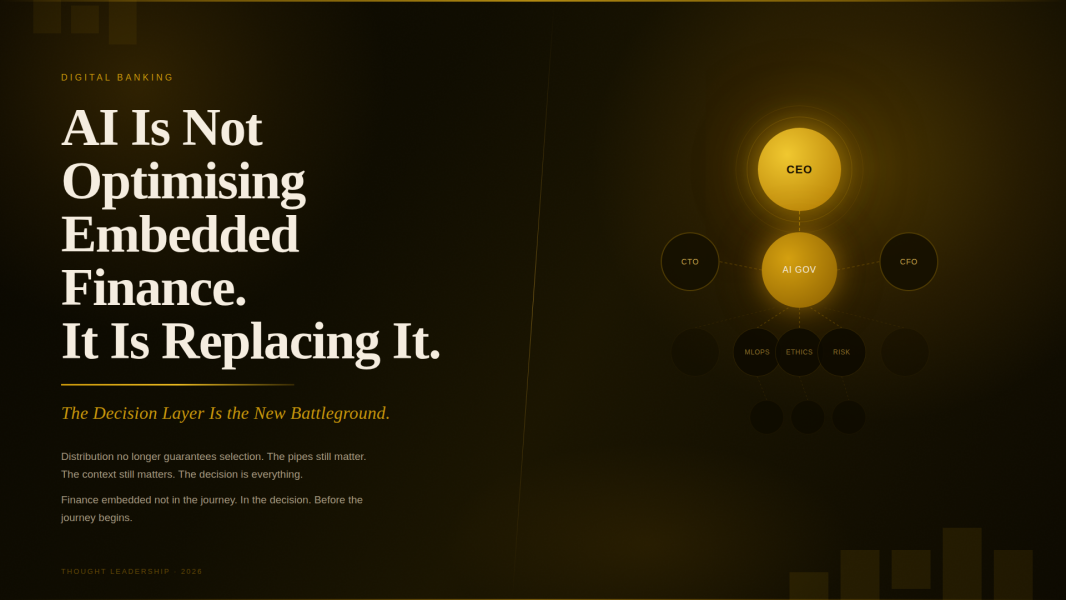
The decision is the new battleground. This is where AI sits. The entity that controls decisioning, timing, risk interpretation, and customer intent modelling controls the economics. Full stop. In practice, very few institutions occupy more than one of these layers well, which is precisely why the scramble for the decision layer is happening now rather than five years from now.
The Risk No One Is Pricing Properly
McKinsey Global Institute estimates AI could add between USD 200 billion and USD 340 billion in annual value to the global banking sector, equivalent to 9 to 15 percent of operating profits. That number appears in every AI strategy deck doing the rounds right now.
What gets quoted far less often is the finding sitting next to it.
McKinsey’s own 2024 survey of 44 financial institutions found that while 52% of senior leaders have positioned gen AI as a priority, most banks remain in the experimental phase, progress has been slower than expected, and only a handful of larger institutions are genuinely ahead of the curve.
The gap between ambition and execution is wide. It is not, however, the most dangerous risk on the table.
The harder question is this: when AI controls credit decisions at scale, who is accountable for the outcome? When a model systematically underscores a customer segment because the training data reflected decades of historical bias, who owns that failure? When interconnected AI systems across thousands of institutions make correlated decisions simultaneously, what does a systemic shock look like in that environment?
I have spent 25 years building inside regulated financial systems across four continents. The institutions that have failed fastest are always the ones that adopted powerful new capabilities without honestly interrogating what could go wrong.
Embedded finance tightly coupled banks to platforms. Most institutions understood that dependency, even if they did not always manage it well. AI tightly couples decisions to models. That is a different category of risk, and the industry is not yet managing it with the rigour it demands.
What Winning Looks Like From Here
I see there are three viable positions.
Be the infrastructure. Accept commoditisation. Scale through BaaS. Optimise for volume, reliability, and cost efficiency. There is a real, sustainable business here. A differentiated one? No.
Own the AI decisioning layer. Control credit-state awareness, behavioural interpretation, and real-time eligibility at the model level. McKinsey’s analysis of multiagent AI systems in credit underwriting found productivity gains of 20 to 60 percent and roughly 30 percent faster decision-making. That range is wide because implementation depth varies enormously. The institutions at the top of that range are the ones that rewired entire credit workflows, not just bolted AI onto existing processes.
Own a closed ecosystem. Control both the context and the decision. Rare. Expensive. Genuinely defensible. Very few institutions can realistically execute this, and fewer still will commit to the investment it requires.
Every other position is drift. The banks still treating embedded finance partnerships as a strategy are already finding out what drift looks like: shrinking margin, eroding relevance, and a distribution model that no longer guarantees they get selected at all.
The Bottom Line
That Uber ride at the airport. That feeling of arriving somewhere unfamiliar and having everything just work, no friction, no negotiation, no cognitive load at all. That was embedded finance at its best.
The next version of that moment is already being built. It will not feel like an app. It will not feel like a product. It will not feel like finance at all.
You will land in a city you do not know. Your AI agent will have already assessed your cash position, your spending patterns, your trip duration, and the local cost of living. It will have pre-arranged a credit line at the right limit, at the right price, with the right repayment terms, before you clear immigration. You will not apply, you will not be asked. The decision will have been made, quietly, on your behalf, by a system that understood your financial life better than any bank ever did.
No friction, no form, no moment of need, because the need was anticipated before you felt it.
That is the Uber moment for AI-native finance. The question is not whether it is coming. The question is which institution controls the intelligence that makes it happen, and whose customer walks through that arrivals gate next.
Finance embedded not in the journey. In the decision. Before the journey begins.
BCG is clear on this: institutions that fail to move toward agentic AI risk disintermediation by faster movers. The window is open. It will not stay open indefinitely.
The question every banking executive needs to sit with is not how do we play in embedded finance. It is: where do we sit when AI makes the financial decision, and the customer never even knows one was made?
Whoever controls that moment controls the bank.







Banking 4.0 – „how was the experience for you”
„To be honest I think that Sinaia, your conference, is much better then Davos.”
Many more interesting quotes in the video below: