A Mythos moment? Frontier AI and cyber risk.

Frontier AI models are being adopted by both attackers and defenders. These models can lower the cost of finding and exploiting vulnerabilities for attackers but can also help defenders discover and fix them. The economic costs are, nonetheless, asymmetric: a defender must protect every system continuously, whereas an attacker needs only one viable route in.
Among the most notable capabilities of frontier artificial intelligence (AI) models is their capacity to find vulnerabilities in software and hardware systems. Anthropic’s Mythos, announced on 7 April 2026 and released only to select partners, is a case in point (Carlini et al (2026)). Mythos – and soon thereafter other frontier AI models, such as OpenAI’s GPT-5.5 – is able to not only identify cyber vulnerabilities but also develop exploits to take advantage of them, and to autonomously carry out sophisticated multi-step, multi-vulnerability cyber attacks. Does this represent a “Mythos moment” – a wake-up call that requires a fundamental reconsideration of views on the robustness and resilience of financial market infrastructures?
The financial system is an obvious place of concern for information technology vulnerabilities. Banks, payment systems and other market infrastructures are among the most heavily targeted and most densely interconnected parts of the economy. They depend on long, complex chains of proprietary and open source software as well as third-party suppliers. A step change in attackers’ capabilities could therefore have consequences that extend well beyond any single institution and bear directly on financial stability.
This Bulletin sets out potential channels through which frontier AI models can affect cyber security risk at scale. It discusses the impact of new tools on the capabilities and incentives of both attackers and defenders and draws on available data. Finally, it discusses potential public policy responses to support financial stability.
Key takeaways
. Frontier artificial intelligence (AI) models increase the speed, scale and complexity of cyber attacks, and they also strengthen cyber defence. But the costs are asymmetric and may favour attackers.
. The medium-term impact on systemic cyber risk depends on the various actors’ access to the most advanced tools, on compute power to run the tools and on economic incentives.
. Given the pace of recent developments, swift adoption of frontier AI models to review code bases and fix vulnerabilities is essential. International coordination can support authorities in addressing these issues.
Performance of frontier AI models on cyber security tasks
Frontier AI models have significantly advanced cyber offensive capabilities. For instance, recent evaluations by the UK government’s AI Security Institute (AISI) suggest that frontier models are improving cyberrelevant offensive tasks. AISI tests models on a suite of 95 narrow cyber tasks across four difficulty tiers in a “capture-the-flag” benchmark setting, in which a model must find and exploit a deliberately planted vulnerability to retrieve a hidden token.
Mythos achieved a 68.6% pass rate for expert-level tasks – higher than any model before. Yet these capabilities do not appear to be unique to Mythos. OpenAI’s GPT-5.5, released just weeks after Mythos, performed even better, with a 71.4% pass rate (Graph 1.A; AISI (2026b)). Moreover, in a cyber range, ie long multi-step attack simulations, both Mythos and GPT-5.5 were able to achieve a full network takeover in some attempts (Graph 1.B).
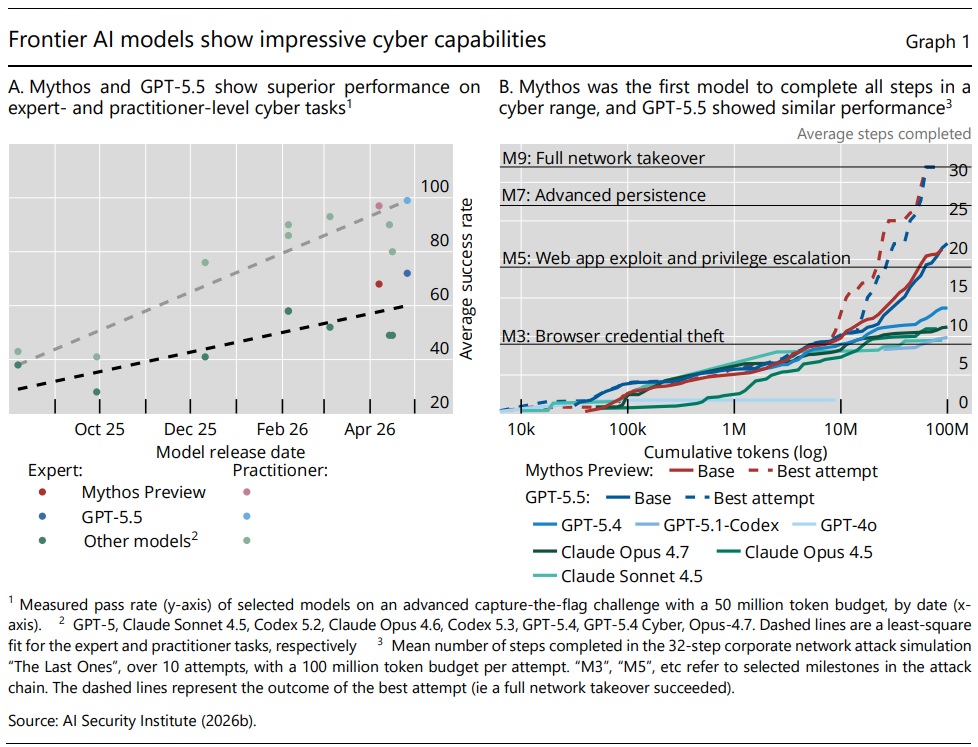
Cyber offence is unusually well suited for frontier AI tools. Unlike many tasks in which an AI system must navigate open-ended ambiguity, an attack unfolds as a structured, sequential workflow, codified in widely used industry frameworks. Each stage generates machinereadable outputs (system logs, error messages, code, catalogued vulnerabilities) that a model can parse, reason over and act upon, with the success or failure of one step furnishing immediate feedback for the next. These tight feedback loops, comparatively rare in less structured domains, are precisely the conditions under which such models learn and improve most rapidly.
The inflection point, which Mythos was the first model to reach, arrives not when a model can identify a single exploit, but when it can reliably link steps and adapt them to targets with limited human oversight. Encouragingly, the same properties operate in reverse: defenders can apply identical reasoning to anticipate, detect and remediate intrusions, so advances in model capabilities need not accrue to attackers alone.
There are costs to mounting such an attack, but they are not prohibitive. A full attack chain consumes approximately 100 million tokens (a unit of input or output data). At current cloud prices, running such an attack on Claude Mythos Preview would cost some $5,000–$10,000, depending on the balance between input tokens (the code and data supplied to the model) and the more expensive output and reasoning tokens used to plan and execute it. Other frontier models such as Claude Opus 4.8, Gemini 3.5 and GPT 5.5 would cost about a fifth as much, and cheaper models such as Grok or DeepSeek can cost as little as $50– $100 per attack. As these costs fall, it becomes easier for less sophisticated actors to mount attacks.
These developments have renewed public concern and policy discussions around cyber risk. Supervisors and banks have aired these concerns publicly: some central banks are reported to have questioned banks about their exposure to new models, and senior bank executives have described them as a serious threat while warning that more threats will follow.
More details: BIS Bulletin No. 129








Dariusz Mazurkiewicz – CEO at BLIK Polish Payment Standard
Banking 4.0 – „how was the experience for you”
„To be honest I think that Sinaia, your conference, is much better then Davos.”
Many more interesting quotes in the video below: