

A Spanish court has ordered ING to pay more than €101,000 in a case concerning its PSD2 interface, after finding that it used the standardised “ACSP” payment status inappropriately.
For ETPPA, the wider message is clear: “TPPs must be able to rely on accurate information from banks, and on supervisors to act promptly when problems arise”.

The ruling concerns transactions dating back to 2021. The case was registered in 2023, with judgment delivered around three years later. More than eight years after PSD2 became applicable, effective enforcement cannot depend on costly, drawn-out litigation. The forthcoming PSR and PSD3 must deliver faster, more consistent enforcement across Europe.
Read ETPPA’s full statement below:
TPPs should be able to rely on accurate, standardised payment-status information, and on supervisors to act when the rules are not respected. ETPPA welcomes the judgment of the Madrid Court of First Instance No. 15 in proceedings concerning ING’s PSD2 interface. The Court found that the bank had used the standardised ‘ACSP’ transaction status inappropriately and negligently. It ordered ING to pay €101,213.37, plus interest and costs, after 167 payment orders reported as accepted for execution were subsequently rejected for insufficient funds.
The judgment confirms a basic principle of open banking: transaction-status codes are not technical detail. Payment initiation service providers must be able to rely on clear and accurate information from account-servicing banks. If the information supplied through a dedicated interface is unreliable, TPPs, merchants and ultimately consumers bear the consequences.
This is a welcome ruling, but an avoidable court case. This dispute reached the courts after the underlying concerns had already been raised with the competent authorities in Spain and the Netherlands. More than eight years after PSD2 became applicable, a TPP should not have to rely on lengthy and costly litigation to secure compliance with obligations that should be enforced promptly through supervision.
Nor is this an isolated concern. TPPs in Spain and other EU Member States continue to encounter obstacles linked to the reliability and consistent implementation of bank interfaces, as well as slow resolution when problems are reported. Formal access rights have little value if breaches persist without timely investigation, corrective action and meaningful consequences.
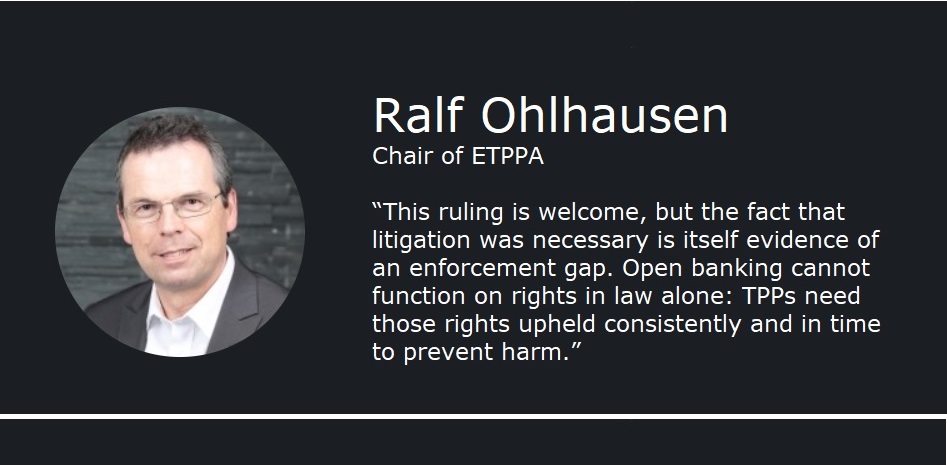
“This ruling is welcome, but the fact that litigation was necessary is itself evidence of an enforcement gap. Open banking cannot function on rights in law alone: TPPs need those rights upheld consistently and in time to prevent harm,” said Ralf Ohlhausen, Chair of ETPPA.
PSR and PSD3 must close the enforcement gap. The provisional political agreement on the new Payment Services Regulation (PSR) and PSD3 is an opportunity to strengthen open banking and remove discriminatory obstacles. But new rules will succeed only if they are enforced consistently across the Single Market.
ETPPA calls on the European Commission and the European Banking Authority, within their respective mandates, to:
● establish clear, technology-neutral and consistently applied expectations for accurate transaction-status information and reliable interfaces;
● monitor national implementation and supervisory practices, address persistent divergence or inaction, and take appropriate action where systemic failures to apply EU law are identified; and
● promote effective supervisory convergence so that TPP complaints are investigated promptly by national competent authorities and result in timely remediation and, where appropriate, effective sanctions.
The PSR’s directly applicable rules can reduce fragmentation, but only decisive and coordinated enforcement will turn legal access into dependable access across the EU.
Note: Judgment No. 164/2026, 2 June 2026, Ordinary Procedure 741/2023. The judgment was issued at first instance and states that an appeal may be lodged. The PSR/PSD3 package reached provisional political agreement on 27 November 2025; technical work toward formal adoption remains ongoing.
___________
ETPPA is the European trade association of Third Party Providers (TPPs) under PSD2 and beyond. ETPPA represents the interests of TPPs vis-à-vis EU institutions and across various European working groups and multi-stakeholder fora, supporting the development of an innovative, competitive and level playing field for Account Information Service Providers (AISPs) and Payment Initiation Service Providers (PISPs).




Banking 4.0 – „how was the experience for you”
„To be honest I think that Sinaia, your conference, is much better then Davos.”
Many more interesting quotes in the video below: