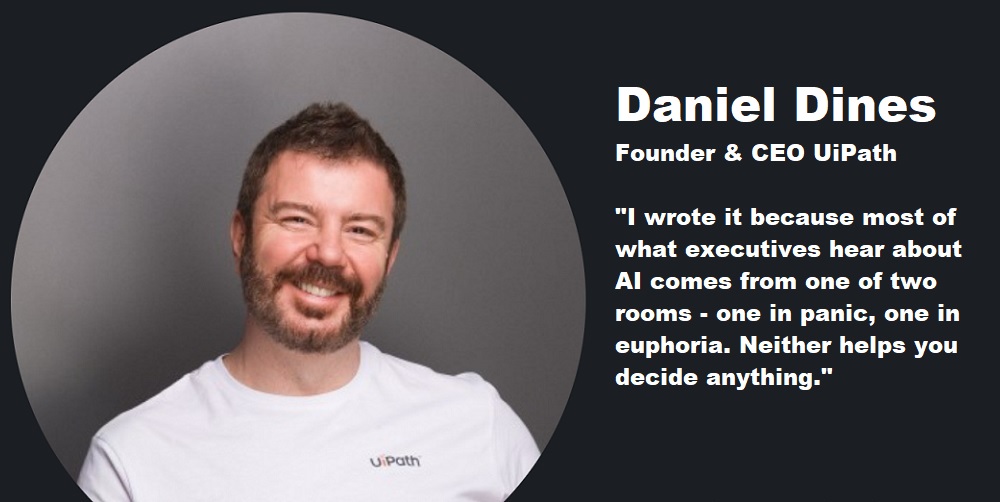
Founder and CEO Daniel Dines announced the release of The Work That Remains, a new book offering business and technology leaders a practical framework for orchestrating AI agents, automation, and people while preserving human judgment, accountability, and control.
In his new book, The Work That Remains, Dines examines one of the most consequential questions facing business leaders: as AI becomes capable of performing more knowledge work, how should enterprises redesign work without surrendering judgment, accountability, trust, or control?
„I wrote it because most of what executives hear about AI comes from one of two rooms — one in panic, one in euphoria. Neither helps you decide anything. What enterprises need is a pragmatic account of where AI is genuinely strong, where it is structurally limited, and a deployment model that follows from both. That is what this book tries to be.” – said Daniel Dines, Founder & CEO of UiPath. „I wrote it with Claude and ChatGPT, and the last chapter explains how. I learned more about AI writing this book than in any year of running an AI company.” – he added.
Agents can interpret context, investigate, plan, and prepare work. People remain accountable for decisions involving consequence, trust, and institutional commitment. Deterministic automation executes the approved actions that must be reliable, repeatable, and auditable.
“The real project of enterprise AI is… not procuring agents. It is producing a governed description of how the business actually works – the map – and the machinery that executes stable parts exactly – the rails” – the author said.
Dines describes the book as an accessible guide for leaders trying to make sense of a rapidly changing AI landscape. “You’ll learn more about AI in four hours than you did in the last year,” he added.
WHY NOW:
Enterprises are moving quickly to deploy AI, but many remain caught between isolated pilots and production systems that can deliver measurable, governed outcomes. Dines argues that the missing layer is orchestration: the structure that coordinates work across agents, robots, people, applications, and time, while governing what becomes official.
Dines suggests that the next phase of enterprise AI will not be defined by which organization has access to the most powerful model. Rather it will be defined by which organizations can build a governed map of how work happens, and the execution rails needed to turn intelligence into reliable action. The future of AI requires architecture that makes AI safe, scalable, and trustworthy. With orchestration, organizations have the structure needed to move from AI complexity to coordinated, measurable outcomes.
__________
Dines Dines has spent more than two decades building UiPath in pursuit of one goal; to eliminate the manual, repetitive work that slows down teams and organizations. He’s dedicated his career to working with organizations to understand how enterprise processes, automation, and human decision-making operate at scale. In the book, he draws on that experience to outline a new operating model for the agentic enterprise.
The Work That Remains is available to download at: https://www.uipath.com/the-work-that-remains




Banking 4.0 – „how was the experience for you”
„To be honest I think that Sinaia, your conference, is much better then Davos.”
Many more interesting quotes in the video below: