
Payments used to be judged by whether they moved money quickly. Now they are judged by how well they make decisions before, during and after a transaction.
The PYMNTS Intelligence report “Where Payment Decisions Happen: How Issuer Data Is Powering the Next Era of Commerce,” a collaboration with FIS, found that issuer processing is moving from a back-end utility into a source of real-time intelligence. Issuers sit close to the data that shapes payment outcomes, including credit profiles, transaction histories, risk signals, rewards structures and customer behavior. As commerce becomes more digital and automated, that data can help banks and other financial institutions improve approvals, reduce fraud and create smoother customer experiences.
„Issuers already hold much of the information needed to make payments work better. The challenge is turning that information into something useful when a transaction happens. Like an air traffic controller, the modern issuer processor must see more than one plane on the radar. It must understand the full pattern of activity, spot risk quickly and keep legitimate transactions moving.” – according to PYMNTS Intelligence.
Key findings from the report include:
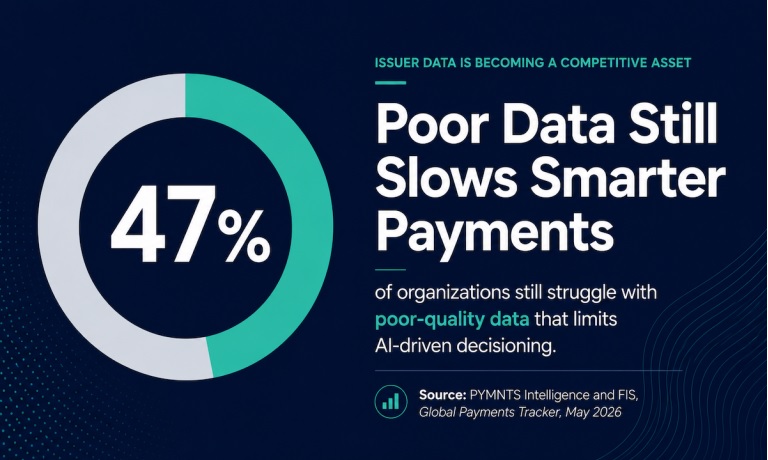
. The share of organizations that struggled with poor-quality data that limits the effectiveness of AI-driven decisioning was 47%. Payment intelligence depends on clean, connected data, including transaction histories, behavioral signals and risk profiles.
. Issuers falsely declined roughly 15% of legitimate eCommerce transactions, contributing to an estimated $430 billion in lost sales globally each year. The problem is especially acute in card-not-present commerce, where issuers lack physical signals such as chip inserts, contactless taps or PIN entry.
. Although issuers reported average fraud losses of about $239 million across the payment journey, 42% said AI has helped them save more than $5 million from fraud attempts in recent years.
Traditional issuer processing systems were built for reliability, speed and accuracy, not for the kind of dynamic decisioning now required in digital commerce. That difference is becoming more important as transactions rely on contextual signals such as device recognition, updated credentials, spending behavior and prior purchase history.
Data aggregation is also becoming a competitive dividing line. The report revealed that 55% of organizations said they have unified more than half of their data, but data quality still holds many firms back. Collecting data is no longer enough. Issuers need platforms that can activate that data in real time.







Banking 4.0 – „how was the experience for you”
„To be honest I think that Sinaia, your conference, is much better then Davos.”
Many more interesting quotes in the video below: