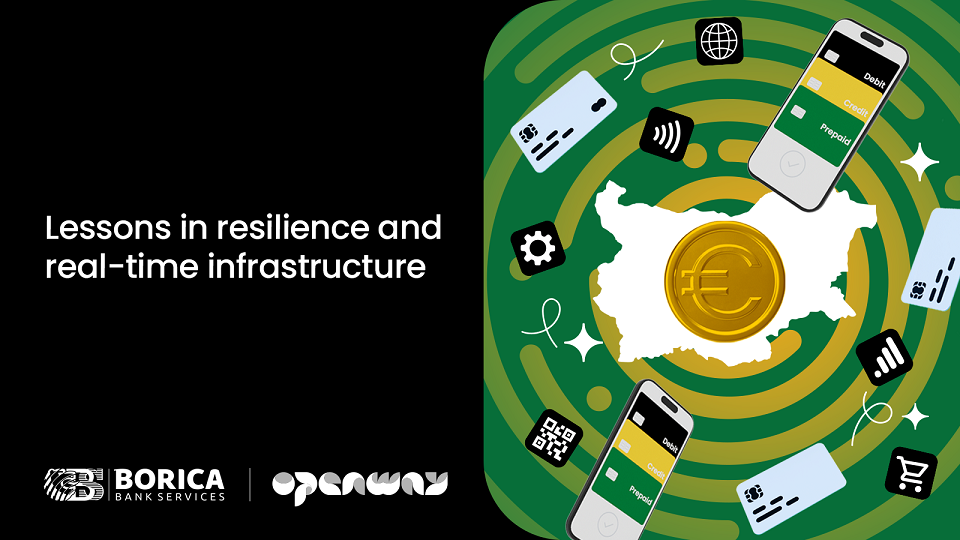
Bulgaria’s euro adoption required a synchronized transformation across banks, PSPs, fintechs, schemes, ATMs, POS networks, and national payment infrastructure — all while live transactions continued to flow. Within the first 48 hours, more than 930,000 transactions were processed, representing nearly €42 million in volume — with 𝘇𝗲𝗿𝗼 𝘂𝗻𝗽𝗹𝗮𝗻𝗻𝗲𝗱 𝗱𝗼𝘄𝗻𝘁𝗶𝗺𝗲.
an article by Maria Vin is Head of Strategy at OpenWay
When a country changes currency, the public sees new prices, new cash, and new account balances. The harder test happens behind the scenes: whether the national payments infrastructure continues to work from the first minute.
Bulgaria’s adoption of the euro on 1 January 2026 required a live, national-scale payments transformation involving banks, payment service providers, fintechs, government institutions, international schemes, and technology partners. BORICA AD, Bulgaria’s national card and payment infrastructure operator, has described in a new case study how the cutover was executed with ecosystem partners including OpenWay, whose Way4 platform supported BORICA’s card issuing, acceptance, and payment processing environment. Useful lessons can be inferred for all payment companies preparing high-risk infrastructure change.
Lesson 1: Treat the cutover as an ecosystem challenge
The case study, Bulgaria’s Euro Day One: How BORICA Orchestrated a National Payments Cutover at Scale, shows that successful migration depends on coordination across the full payments ecosystem. More than 35 banks, payment service providers, fintechs, government institutions, and technology partners were involved in synchronized changes to ensure payment continuity across channels.
“The euro transition was a live, national-scale infrastructure transformation that required precise coordination across the payments ecosystem,” said Miroslav Vichev, CEO at BORICA. “Our objective was to ensure that payments worked seamlessly from the first minute of euro adoption, across every channel. This case study captures the operational model behind that outcome.”
Lesson 2: Rehearse the critical window before it arrives
A defining phase was the planned three-hour cutover of the national card infrastructure. During this window, issuing and acquiring systems, POS and ATM devices, and international scheme integrations were updated simultaneously to support euro-denominated transactions.
This highlights a central lesson for other markets: the most visible moment of change must be prepared long before the cutover begins. Governance, testing, escalation paths, partner readiness, and operational rehearsals are as important as the technology itself.
Lesson 3: Treat the processing platform as part of national resilience
In a national currency migration, the processing platform is not a back-office component. It becomes part of the country’s operational resilience layer.
According to BORICA, more than 930,000 card and ATM transactions worth nearly EUR 42 million were processed within the first 48 hours of euro adoption, with zero unplanned downtime. The first successful euro ATM withdrawal was recorded just 20 seconds after midnight, followed by card and digital payment transactions within minutes.
This outcome depended not only on project governance and ecosystem coordination, but also on the readiness of the platform layer. OpenWay’s Way4 platform supported BORICA’s card issuing, acceptance, and payment processing operations, helping maintain transaction traceability, reconciliation integrity, and operational stability under real-time load.
The point for other markets is clear: resilience in a currency cutover is designed long before midnight. It sits in the architecture, testing model, partner coordination, and the ability of the processing platform to absorb synchronized change without interrupting live services.
The case also illustrates the value of long-term technology partnership. BORICA and OpenWay have worked together since 2018 on modernizing Bulgaria’s card infrastructure, making Way4 an established processing platform within BORICA’s national payments environment by the time of the euro transition.
Lesson 4: Protect the wider digital payments ecosystem
The case study also shows that continuity must extend beyond card processing. Value-added services including blink instant payments, B-Trust digital identity, SoftPOS solutions, and e-voucher platforms remained operational during the transition.
For payment infrastructure operators, this is an important point: customer impact is shaped by the full ecosystem of services, not by core transaction processing alone.
Lesson 5: Align regulation, settlement, and infrastructure early
Regulatory and infrastructure alignment played a central role in the transition. BORICA now operates as an ancillary system within TARGET and is connected to TARGET Instant Payment Settlement, allowing Bulgarian banks to offer instant euro transfers across SEPA.
For other markets, this reinforces the need to treat legal, settlement, and operational readiness as connected workstreams rather than separate milestones.
More details here: How to ensure a national-wide payments infrastructure survives an operational stress test




Banking 4.0 – „how was the experience for you”
„To be honest I think that Sinaia, your conference, is much better then Davos.”
Many more interesting quotes in the video below: