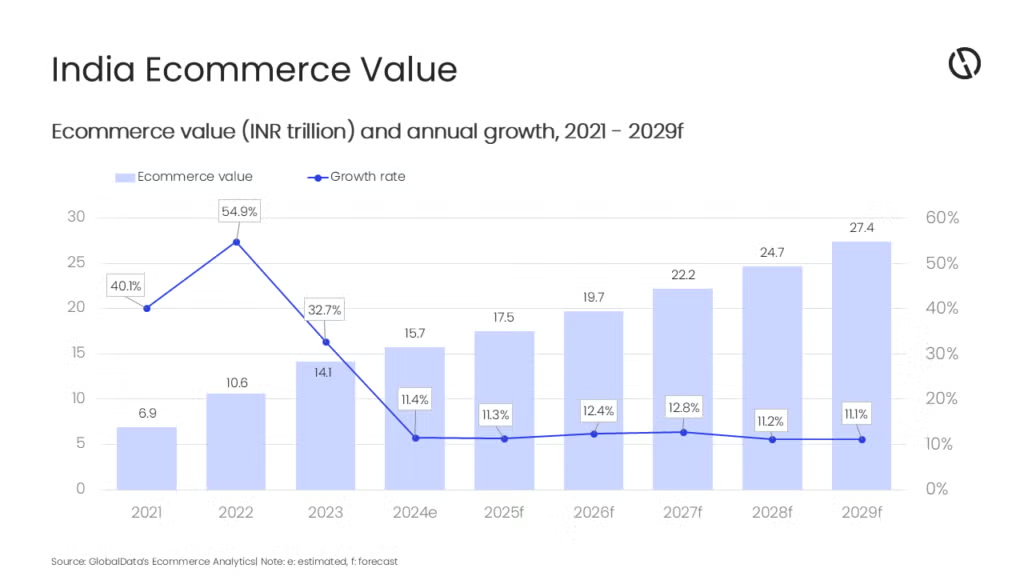
India’s e-commerce market is forecast to grow by 12.4% in 2026, reaching INR19.7 trillion ($225.9 billion). This rapid growth will be driven by strong consumer appetite for online shopping and growing trust in digital payments. The sector’s momentum reflects deeper digital integration, government-led policy support, and rising adoption of AI-driven shopping innovations, according to GlobalData.
GlobalData’s Ecommerce Analytics reveals that India’s e-commerce market registered an estimated growth rate of 11.3% in 2025, to reach INR17.5 trillion ($200.9 billion). This growth was driven by an increasing number of consumers shifting from offline to online purchases, due to the convenience and promotional activities undertaken by online retailers. The market is projected to reach INR27.4 trillion ($314.5 billion) in 2029.


Kartik Challa, Senior Banking and Payments Analyst at GlobalData, comments: “The e-commerce market in India has experienced rapid growth in recent years, driven by broader digital adoption, increasing internet and smartphone penetration, and the availability of secure online payment tools. Online retailers are increasingly using AI to personalize product discovery, compare products, support advanced search, and tailor content by region and consumer behavior. All these factors have supported the surge in India’s online shopping market.”
Government and private-sector initiatives are another key driver of e-commerce growth. The Indian government’s Goods and Services Tax (GST) rate cuts, effective from September 2025, on food and household essentials, electronics, and fashion and wellness products also supported discretionary spending and e-commerce sales.
Leading e-commerce firms, including Reliance Retail, Amazon, and Flipkart, participated in the government’s 100-day “GST Bachat Utsav” campaign, which required retailers to display GST discounts on invoices and submit reports on benefits passed to consumers. Likewise, in December 2024, Amazon partnered with the government’s Startup India initiative to help startups build and scale their e-commerce businesses through mentorship, training, and access to Amazon’s technology, tools, and marketplace.
International and domestic companies are also entering the Indian e-commerce market to take advantage of the growth potential. For instance, in February 2025, Shein re-entered India via a partnership with Reliance Retail under the platform “Shein India Fast Fashion”, initially operating in key cities. In the same month, Swedish furniture giant Ikea launched its e-commerce platform in Delhi-NCR region before launching its physical store in Delhi. In August 2024, international cosmetic brand Chanel launched its e-commerce platform in India.
In terms of payment tools, alternative methods are the preferred options, driven by the convenience and security of digital wallets and the strong preference for Unified Payments Interface (UPI)–based mobile payments among consumers and merchants. International brands such as Google Pay and Amazon Pay remain among the most widely used.
Credit cards are more preferred than debit cards due to the value-added benefits they offer, including interest-free instalment payment options, reward programs, cashback, and discounts. Their usage is set to increase further with banks offering discounts in partnership with online retailers.
Challa concludes: “India’s e-commerce market will continue its upward growth trajectory over the next few years with consumer appetite for online shopping showing no signs of waning. The country’s young, upwardly mobile demographic, growing popularity of alternative payment solutions, favorable regulatory initiatives, and technological advancements are converging to transform how Indians shop—creating new market opportunities, improving customer experiences, and attracting fresh investment.”






Banking 4.0 – „how was the experience for you”
„To be honest I think that Sinaia, your conference, is much better then Davos.”
Many more interesting quotes in the video below: