
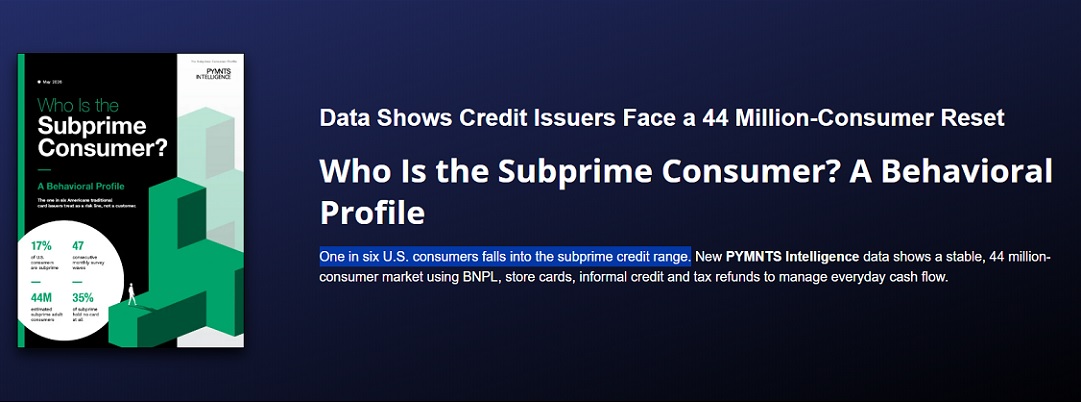
Subprime consumers are navigating the credit markets through a mix of installments, informal borrowing and carefully managed payment behavior that traditional scoring models do not always capture. One in six U.S. consumers falls into the subprime credit range.
PYMNTS Intelligence data on the behavioral profiles of subprime consumers argues that the subprime population represents a durable and identifiable segment of roughly 44 million U.S. adults, rather than a temporary byproduct of economic pressure. The report found that 17% of U.S. consumers identify as subprime, a share that has remained within a relatively narrow range for 47 consecutive monthly survey waves dating back to March 2022.
The stability of that segment matters for lenders, merchants and installment providers because the data suggests these consumers continue to seek credit access, even as many traditional products fail to align with their financial realities. The report notes that 35% of subprime consumers hold no credit or store card at all, compared to just 4% of super-prime consumers.
Subprime consumers heavily favor several BNPL providers, young subprime consumers are using installments for healthcare and 67% of subprime refund recipients say their refund is critical or very important to their finances.
The report repeatedly points to one structural characteristic separating subprime consumers from the broader population: chronic pressure around bill payment. Fifty-five percent of subprime consumers reported living paycheck to paycheck with difficulty paying bills, more than double the rate for the overall population.
Traditional underwriting models remain heavily anchored to credit bureau data, revolving utilization and repayment history. Yet the PYMNTS Intelligence findings suggest that cash-flow behavior, spending priorities and payment sequencing may provide additional insight into repayment capacity and consumer stability.
More details here




Banking 4.0 – „how was the experience for you”
„To be honest I think that Sinaia, your conference, is much better then Davos.”
Many more interesting quotes in the video below: